
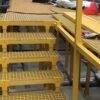
FRP Stair Tread – Safe, Insulated & Anti‑Slip Steps for Highly Corrosive Environments
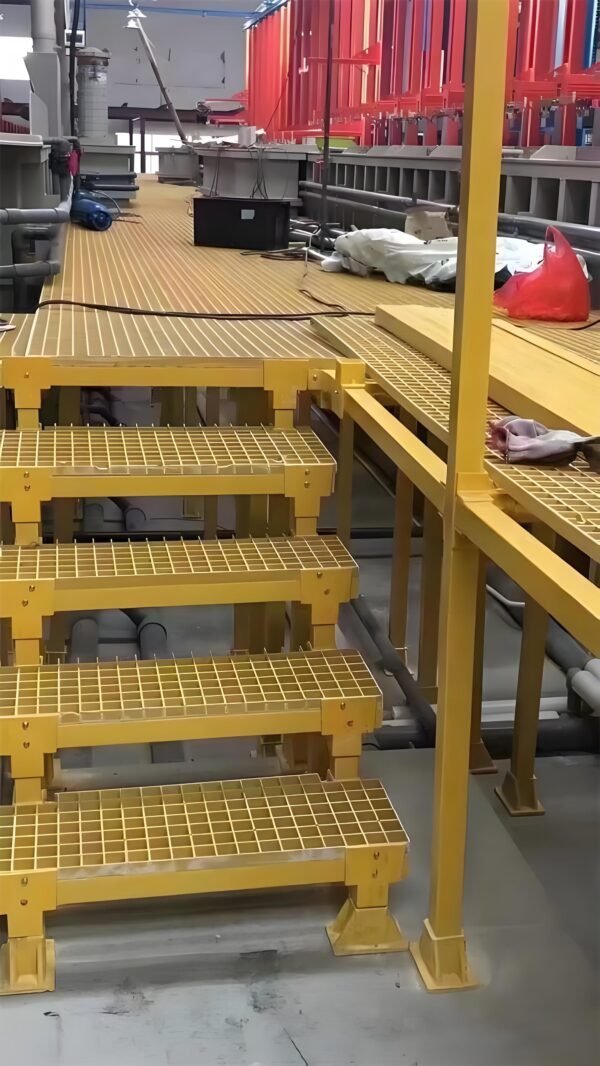
FRP (Fiberglass Reinforced Plastic) stair treads are made of fiberglass reinforcement and resin matrix (unsaturated polyester, vinyl ester, or phenolic) through a molding process. They are widely used for electroplating workshops, chemical plants, offshore platforms, wastewater treatment plants, and substations – where corrosion resistance and electrical insulation are critical. Compared to metal treads (steel, stainless steel, aluminum), FRP treads offer excellent chemical corrosion resistance (strong acids/alkalis), electrical insulation (non‑conductive), non‑magnetic properties, light weight (approx. 1/4 density of steel), flame retardancy, grit‑coated anti‑slip surface (friction coefficient ≥0.8), customizable colors, and maintenance‑free operation.
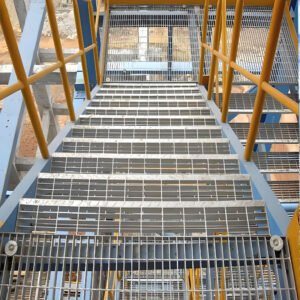
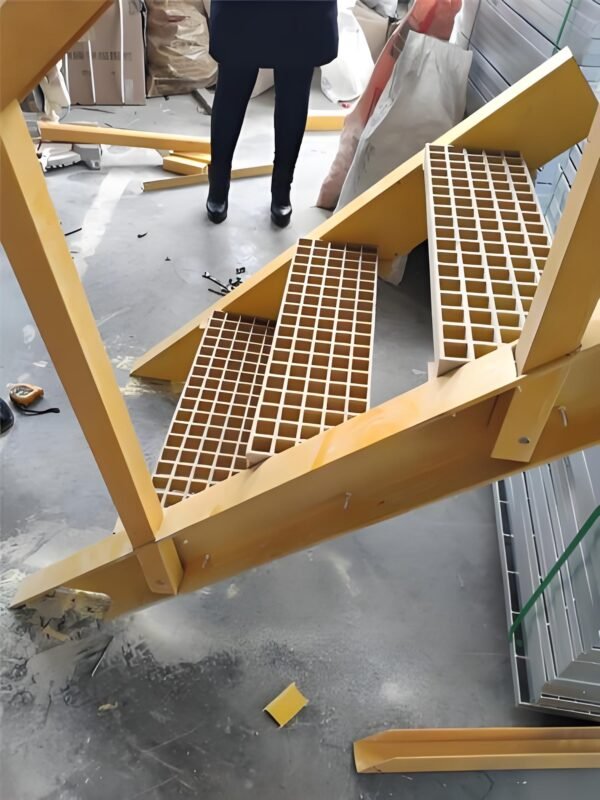
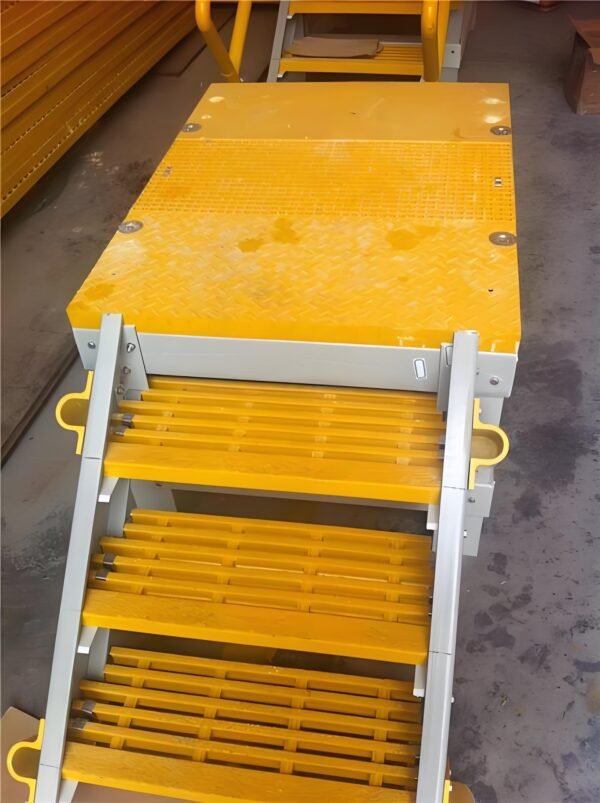
FRP stair treads are typically made in sizes such as 38×38×30 or 25×25×25. The grid design ensures drainage and ventilation. The surface can be grit‑coated for anti‑slip, and the front edge can have a yellow warning strip. Each tread length is customized to stair width. Stainless steel or FRP frames can be added at the ends for bolted connection to stringers.
As a professional manufacturer of FRP stair treads, we provide one‑stop service from resin selection, molding, grit coating, cutting, to export. Below is a complete technical introduction.
1. Material Grade Comparison for FRP Stair Treads (by Resin Type)
The corrosion resistance, temperature resistance, and flame retardancy of FRP stair treads depend mainly on the resin type. The table below lists the most common resin grades – choose according to your chemical media and environment.
| Resin Type | Corrosion Resistance | Max Temp | Flame Rating | Characteristics | Suitable Application |
|---|---|---|---|---|---|
| Orthophthalic Polyester | Fair, mild acid/alkali | ≤80°C | HB (flame retardant optional) | Best cost-effectiveness | Indoor dry, mild corrosion ladders |
| Isophthalic Polyester | Good, better acid/alkali | ≤90°C | HB / flame retardant | Good all-round, water resistant | Wastewater plants, general chemical ladders |
| Vinyl Ester | Excellent, strong acid/alkali & solvents | ≤110°C | Flame retardant (V-0) | Best corrosion resistance | Electroplating, chemical plants, offshore |
| Phenolic | Excellent, solvent resistant, very low smoke | ≤150°C | Flame retardant V-0, low smoke | Fire safety, low smoke toxicity | Oil platforms, tunnels, high‑risk areas |
Recommendation: For most corrosive environments, isophthalic polyester is sufficient. For electroplating and strong acid/alkali, vinyl ester is recommended. For high fire safety, phenolic resin is recommended.
2. Load Classes & Selection Principles for FRP Stair Treads
The load capacity of FRP stair treads depends on mesh size, bar height, tread width, and support method. The table below lists common load classes and recommended models:
| Load Class | Reference Load | Typical Application | Recommended Model | Tread Width (mm) | Max Span |
|---|---|---|---|---|---|
| Light | ≤1 t/m² | Personnel access, indoor light ladders | 25×25×25 | 200–250 | ≤600mm |
| Light-Medium | 1–2 t/m² | General industrial maintenance, wastewater stairs | 38×38×25 | 250–300 | ≤750mm |
| Medium | 2–3 t/m² | Chemical plant stairs, electroplating stairs | 38×38×30 | 250–300 | ≤900mm |
| Heavy | 3–4 t/m² | Light equipment stairs, offshore (closer supports) | 50×50×50 | 300–350 | ≤1000mm (verify) |
Selection Principles:
-
FRP treads are not recommended for heavy truck or heavy equipment traffic – choose heavy steel grating treads.
-
Smaller mesh size = higher load capacity (25×25 > 38×38 > 50×50).
-
Grit‑coated anti‑slip surface is standard – essential for wet/oily environments.
-
For highly corrosive environments, use vinyl ester or phenolic resin.
-
A yellow warning nosing is recommended for safety visibility.
3. Specification & Load Table for FRP Stair Treads
The table below lists the most common specifications for molded FRP stair treads. All models can be custom-sized.
| Model | Mesh Size (mm) | Bar Height (mm) | Opening (mm) | Unit Weight (kg/m²) | Suitable Load | Typical Application |
|---|---|---|---|---|---|---|
| 25×25×25 | 25×25 | 25 | 19×19 | 14 | ≤1 t/m² | Indoor light ladders, access |
| 38×38×25 | 38×38 | 25 | 32×32 | 17 | 1–2 t/m² | Wastewater stairs, general industrial |
| 38×38×30 | 38×38 | 30 | 32×32 | 21 | 2–3 t/m² | Chemical plants, electroplating |
| 38×38×38 | 38×38 | 38 | 32×32 | 26 | 3–4 t/m² | Offshore platforms, heavy areas (closer supports) |
| 50×50×50 | 50×50 | 50 | 44×44 | 30 | 3–4 t/m² | High drainage requirement stairs |
Specification Notes:
-
Resin types: Orthophthalic, Isophthalic, Vinyl ester, Phenolic
-
Colors: Yellow (standard), grey, green, red, blue, black (customizable)
-
Surface finish: Grit‑coated (standard, friction coefficient ≥0.8), textured, smooth
-
Flame rating: Standard HB, flame retardant V‑2, V‑1, V‑0 (depending on resin)
-
Frame: Stainless steel frame or FRP frame
-
Applicable standards: GB/T 17888.3-2008, ISO 14122-3, OSHA 1910.24
4. Full Product Line of FRP Stair Treads
4.1 Standard Grit‑Coated FRP Stair Tread
The most common type – surface evenly coated with quartz or aluminum oxide sand, friction coefficient ≥0.8. The front edge can have a yellow warning area (no grit or yellow paint) for safety. Suitable for most industrial corrosive environment stairs.
Common sizes: 38×38×30 grit-coated, 25×25×25 grit-coated
Features: Excellent slip resistance, oil and chemical resistant, customizable colors.
4.2 FRP Stair Tread with Frame (Bolted Type)
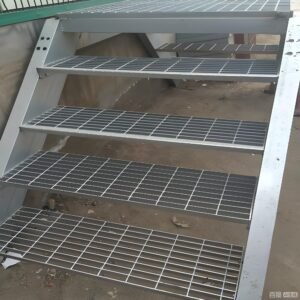
Stainless steel or FRP frames are attached at both ends with pre‑drilled bolt holes for bolted connection to stair stringers. Ideal for stairs requiring disassembly or where field drilling is not allowed.
Common sizes: 38×38×30 with stainless frame, 50×50×50 with FRP frame
Features: Easy installation and removal, frame protects edges, extends service life.
4.3 FRP Stair Tread with Yellow Warning Nosing
The front 25–50mm of the tread uses yellow resin or yellow grit, forming a visible warning strip to highlight the step edge. Meets OSHA safety standards.
Common sizes: 38×38×30 yellow nosing, 25×25×25 yellow nosing
Features: High visibility, improves stair safety, especially in low‑light conditions.
4.4 Fully Grit‑Coated FRP Stair Tread (No Frame)
Full surface grit coating, no frame – lighter weight, lower cost. Suitable for indoor or light ladders where edge protection is not critical.
Common sizes: 25×25×25 fully coated, 38×38×25 fully coated
Features: Full anti‑slip surface, simple and economical.
4.5 Custom‑Shape FRP Stair Tread
Sector, trapezoidal, or curved treads for special stair designs (e.g., spiral stairs, corner landings). CNC cut from CAD drawings, edges sealed with resin.
Applications: Sector stair landings, curved FRP ladders, corner access stairs
5. Key Design Elements for FRP Stair Treads
5.1 Anti‑Slip Design (Safety First)
| Anti‑Slip Type | Structure | Friction Coefficient | Typical Application |
|---|---|---|---|
| Grit‑coated (standard) | Quartz/alumina sand on surface | ≥0.8 | Wet, oily, chemical, sloped stairs |
| Textured | Mold texture or mechanical sanding | 0.5–0.6 | Dry, mildly wet conditions |
| Smooth | As molded | 0.4–0.5 | Dry only – not recommended for stairs |
| Yellow warning nosing | Yellow grit or paint at front edge | ≥0.8 | Edge visibility – recommended for all stairs |
Standard configuration: Grit‑coated + yellow warning nosing – meets safety requirements for most industrial stairs.
5.2 Stair Tread Dimensions
| Parameter | Recommended Value | Notes |
|---|---|---|
| Tread width (depth) | 200–300mm | 250mm is most comfortable (ergonomics) |
| Tread length | 600–1200mm | Custom based on stair width |
| Riser height | 150–200mm | Typically ~175mm, determined by stair design |
| Nosing overhang | 20–30mm | Should project ~25mm below tread |
5.3 Installation Methods
| Method | Operation | Typical Application |
|---|---|---|
| Bolted | Stainless bolts through pre‑drilled holes or frame to stringers | Recommended – removable |
| Clip fixation | FRP/stainless mounting clips | Temporary stairs, access ladders |
| Inserted | Tread ends inserted into slotted stringers | Prefabricated stairs, quick installation |
Recommended method: Bolted connection. FRP is easy to drill on site.
5.4 Load & Deflection Control
-
Design live load for stair treads: industrial ≥3 kN/m², general access ≥2.5 kN/m²
-
Maximum allowable deflection: span / 150
-
Recommended support span (stringer spacing) ≤900mm (adjust based on load)
5.5 Flame Retardancy & Safety
-
General environment: HB grade (horizontal burn)
-
Fire‑rated areas: Use flame retardant resin (V‑2, V‑1, V‑0)
-
High‑risk areas (oil platforms, tunnels): Use phenolic resin (low smoke, low toxicity, V‑0)
5.6 Insulation Properties
FRP is completely non‑conductive, with resistivity >10¹² Ω·cm. Ideal for stairs in substations, switchgear rooms, and electrolysis workshops.
6. Production Process of FRP Stair Treads
Our plant uses the molding process to ensure consistent product performance. The process is as follows:
1. Raw material inspection – Fiberglass, resin, color paste, grit material inspection
2. Molding:
-
Lay fiberglass roving evenly in the mold
-
Inject resin (isophthalic/vinyl ester/phenolic) with color paste
-
Compression mold under high temperature and pressure
-
Trim edges after demolding
3. Grit coating – Apply quartz or aluminum oxide sand to the partially cured surface and cure with resin. Yellow warning nosing can be achieved by zone coating or post‑painting.
4. Cutting & hole drilling – Diamond blade cutting to required dimensions; drill bolt holes
5. Frame assembly (optional) – Stainless steel or FRP frame bolted on
6. Edge sealing – Seal cut edges with resin to prevent fiber exposure
7. Final inspection:
-
Full visual inspection (no bubbles, no delamination, uniform grit coating)
-
Dimensional accuracy check
-
Flame retardancy sampling test
-
Anti‑slip coefficient sampling test
Quality commitment: Each batch includes material specification and flame rating report. Third‑party inspection available.
7. Installation & Fixing of FRP Stair Treads
FRP stair treads are lightweight (approx. 1/4 of steel), easy to install, but dust protection is needed during cutting.
7.1 Bolted Installation (Recommended)
-
Use M8–M12 stainless steel bolts (304 or 316L)
-
Pre‑drill holes or drill on site (diamond bit)
-
Bolt torque: 5–10 N·m (avoid crushing FRP)
-
Use large diameter stainless steel washers to distribute pressure
-
Minimum 4 bolt connection points per tread
7.2 Clip Installation
-
Use FRP‑specific mounting clips (M/C/G type, stainless steel or FRP)
-
Minimum 4 clips per tread
7.3 Installation Notes
-
The long side of the mesh (load direction) must be perpendicular to walking direction
-
Stringer spacing must not exceed design span
-
Levelness deviation per tread ≤3mm
-
Height difference between adjacent treads ≤5mm
-
Wear a dust mask when cutting; use a diamond blade
-
Seal cut edges with resin
-
Avoid concentrated impact loads on a single point
7.4 Acceptance Criteria
-
No warping, delamination, or bubbles
-
Uniform grit coating, no shedding
-
Bolts properly torqued, no looseness
-
Yellow warning nosing clearly visible
-
No abnormal noise or wobbling during walk test; good slip resistance
8. Typical Application Industries for FRP Stair Treads
| Industry | Recommended Resin/Model | Features | Key Requirements |
|---|---|---|---|
| Electroplating / Surface Finishing | Vinyl ester, 38×38×30 grit | Strong acid resistance, oxidation resistance, insulation, anti‑slip | Vinyl ester, grit‑coated, yellow nosing |
| Chemical / Petrochemical | Vinyl ester or phenolic, 38×38×30 | Solvent resistance, flame retardant | Flame retardant, grit‑coated |
| Marine / Shipbuilding | Vinyl ester, 38×38×30 grit | Seawater resistance, salt spray, lightweight | Vinyl ester, grit‑coated |
| Wastewater Treatment | Isophthalic, 38×38×25 | Microbial corrosion resistance, humidity | Isophthalic, grit‑coated |
| Power / Substation | Isophthalic or phenolic, insulated | Electrical insulation, non‑magnetic, flame retardant | Insulated, flame retardant, yellow nosing |
| Food / Pharmaceutical | Isophthalic or vinyl ester, grit | Detergent resistant, easy clean, anti‑slip | Grit‑coated, easy clean |
| Oil Platforms | Phenolic, 38×38×30 grit | Fire safety, low smoke, hydrocarbon resistant | Phenolic, low smoke, yellow nosing |
9. Customization & Procurement Guide
As a direct manufacturer of FRP stair treads, we offer comprehensive custom services:
-
✅ Resin types: Orthophthalic polyester, Isophthalic polyester, Vinyl ester, Phenolic
-
✅ Mesh sizes: 25×25, 38×38, 40×40, 50×50 mm; bar heights 25/30/38/50mm
-
✅ Tread dimensions: Width 200–350mm, length 600–1500mm (from CAD drawings)
-
✅ Colors: Yellow (standard), grey, green, red, blue, black (customizable)
-
✅ Surface finish: Grit‑coated (standard), textured, smooth
-
✅ Nosing treatment: Yellow warning area (grit or paint), standard
-
✅ Flame rating: Standard HB, flame retardant V‑2, V‑1, V‑0 (depending on resin)
-
✅ Frame: Stainless steel frame, FRP frame (with bolt holes)
-
✅ Custom shapes: Sector, trapezoidal, curved treads
Packaging: Wooden pallet or plywood crate, with foam or cardboard separators between treads.
Lead time: ≤500 pieces → 7–10 days; >1000 pieces → 15–20 days
Incoterms: FOB Tianjin/Shanghai/Ningbo, CIF major ports, or EXW factory