

Stainless Steel Drainage Trench Cover – Specification & Selection Guide
304 / 316L – How to Choose Corrosion‑Resistant, High‑Strength Stainless Steel Trench Covers for Your Drainage System?
Stainless steel drainage trench covers offer excellent corrosion resistance, high strength, cleanliness, and aesthetic appeal. They are widely used in food processing plants, chemical plants, pharmaceutical workshops, coastal facilities, and commercial plazas – where hygiene and corrosion resistance are critical. Compared to cast iron covers, stainless steel covers do not rust and have a longer service life. Compared to hot-dip galvanized covers, they perform better in highly corrosive environments.
This article systematically introduces material grades, specifications, load classes, selection principles, and installation points for stainless steel drainage trench covers.
1. Stainless Steel Material Grade Comparison
The most common materials for stainless steel trench covers are 304 and 316L. They differ significantly in corrosion resistance and cost.
| Grade | Cr% | Ni% | Mo% | Corrosion Resistance | Typical Application | Relative Cost |
|---|---|---|---|---|---|---|
| 304 | 18-20 | 8-10.5 | – | General corrosion resistance, not chloride‑resistant | Indoor food plants, general industry, dry environments | Baseline |
| 316L | 16-18 | 10-14 | 2-3 | Chloride‑resistant, seawater‑resistant, pitting‑resistant | Coastal outdoor, chemical plants, pharmaceutical, frequent washing | ~1.3-1.5x |
Selection advice: For indoor dry environments, 304 is sufficient. For coastal areas, chemical plants, or chloride exposure, 316L is mandatory.
2. Common Specification & Parameter Table
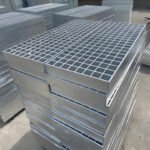
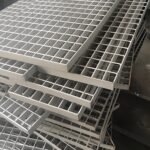
Stainless steel trench covers are typically made from steel grating panels, welded or press‑locked, with pickled and passivated surfaces. Below are the most common specifications.
2.1 Bar Sizes & Recommended Spans
| Model | Bar Size (mm) | Bar Pitch (mm) | Cross Bar Pitch (mm) | Max Span (Pedestrian) | Max Span (Light Vehicle) |
|---|---|---|---|---|---|
| G203/30/100 | 20×3 | 30 | 100 | 800 mm | Not recommended |
| G255/30/100 | 25×5 | 30 | 100 | 1000 mm | 600 mm |
| G255/40/100 | 25×5 | 40 | 100 | 1000 mm | Not recommended |
| G325/30/100 | 32×5 | 30 | 100 | 1200 mm | 800 mm |
| G325/40/100 | 32×5 | 40 | 100 | 1200 mm | Not recommended |
| G405/30/100 | 40×5 | 30 | 100 | 1500 mm | 1000 mm |
Note: Pedestrian = personnel only (≤2 kN/m²). Light vehicle = cars, SUVs, small trucks (≤5 t/m²). For heavy vehicle traffic, choose taller bars or closer supports.
2.2 Common Dimensions
Cover dimensions are customized based on trench width. Common standard sizes:
| Trench Width (mm) | Cover Length (mm) | Cover Width (mm) | Frame Option |
|---|---|---|---|
| 300 | 500 / 600 / 800 | 300 | Angle/flat bar |
| 400 | 600 / 800 / 1000 | 400 | Angle/flat bar |
| 500 | 600 / 800 / 1000 | 500 | Angle/flat bar |
| 600 | 800 / 1000 / 1200 | 600 | Angle/flat bar |
Custom sizes available. Contact sales for minimum order quantity.
3. Load Classes & Selection Guide
Based on installation location and expected load, we define three load classes for stainless steel trench covers:
| Load Class | Design Load (kN/m²) | Typical Application | Recommended Model | Frame Requirement |
|---|---|---|---|---|
| Light | ≤ 2 | Sidewalks, plazas, indoor drains | G203/30/100 or G255/40/100 | Optional |
| Medium | 2 – 5 | Parking lots, general factory roads | G255/30/100 or G325/40/100 | Recommended |
| Heavy | 5 – 8 | Light vehicle lanes, docks, chemical plants | G325/30/100 or G405/30/100 | Mandatory |
Important: For frequent forklift traffic or heavy truck areas (>8 kN/m²), use hot-dip galvanized steel grating or thicker stainless bars (e.g., 50×5) with closer supports.
4. Core Selection Principles
Principle 1: Choose material based on environment
- Indoor, dry, no chlorides → 304
- Outdoor, humid, coastal, chemical plants, saltwater or chemical exposure → 316L
Principle 2: Choose bar height based on load
- Pedestrian only → bar height 20-25mm
- Occasional light vehicle → bar height 25-32mm
- Frequent vehicle traffic → bar height 32-40mm, or 50mm if needed
Principle 3: Bar pitch affects load capacity and drainage
- 30mm pitch: Higher load capacity, better fall prevention – for vehicle traffic
- 40mm pitch: Faster drainage, more economical – for walkways
Principle 4: Frame improves rigidity and safety
- Unframed: For low loads, direct placement
- Framed (angle or flat bar): Increases rigidity, prevents edge curling – for vehicle traffic
- Hinged: Easy cleaning – for drains requiring regular maintenance
Principle 5: Surface treatment requirement
After welding, stainless steel trench covers must be pickled and passivated to restore corrosion resistance. Our plant provides a blue dot test report with every batch.
5. Installation & Fixing Methods
| Method | Operation | Typical Application | Advantage |
|---|---|---|---|
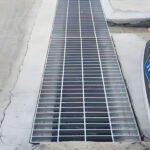
| Direct placement | Cover placed into trench frame with gaps | Sidewalks, plazas | Simple, can be lifted anytime |
| Bolted | Holes in frame, fastened with stainless bolts | Vehicle traffic areas, public areas | Secure, anti‑theft bolts available |
| Hinged | Hinges on one side, cover lifts open | Drains needing regular cleaning | Easy maintenance, cover not lost |
| U‑channel embedded | Cover sits into pre‑embedded U‑channel, flush with ground | Commercial plazas, pedestrian streets | Hidden, aesthetic |
Installation clearance: Leave 5-10mm gap between cover and frame to accommodate thermal expansion and installation tolerances.
6. Selection Calculation Example
Project background: Outdoor drainage trench at a coastal food processing plant. Trench width 400mm, support span 800mm. Load: personnel and light hand truck (total weight 300 kg).
Step 1 – Determine material
Coastal environment with salt spray → 316L stainless steel.
Step 2 – Determine load class
Personnel + hand truck → estimated 3 kN/m² → Medium class.
Step 3 – Select model from table
Medium class recommends G255/30/100 or G325/40/100. Support span 800mm – both are acceptable. Considering occasional hand truck, choose higher capacity: G255/30/100 (25×5, 30mm pitch).
Step 4 – Frame selection
Vehicle traffic area → recommend frame (30×3 angle bar) for rigidity.
Step 5 – Surface treatment
Pickling & passivation – matte silver white.
Final recommendation:
G255/30/100 SS316L with frame, size 400×600mm, pickled & passivated.
7. Frequently Asked Questions
Q1: Do stainless steel trench covers rust?
A: Under normal conditions, 304 and 316L do not rust. However, in high‑chloride environments (e.g., long‑term seawater immersion), 304 may pit – use 316L.
Q2: Can stainless steel covers handle truck traffic?
A: Yes, but choose taller bars (e.g., 40×5 or 50×5) and closer supports. Provide load parameters for a calculation.
Q3: Are hinged covers theft‑proof?
A: Hinges alone are not anti‑theft. Add anti‑theft bolts or locks if needed.
Q4: How much more expensive than galvanized covers?
A: Initial cost is approx. 1.5-2x that of galvanized, but life‑cycle cost is lower due to no replacement or maintenance.
Q5: Can you customize non‑standard sizes and colors?
A: Yes. Provide CAD drawings. Surface finishes include brushed, mirror polished, or colored coating.
8. Summary – Five‑Step Selection Method
- Identify environment → choose material (304 or 316L)
- Determine load → choose load class (Light/Medium/Heavy)
- Measure trench width and support span → determine cover dimensions and bar height
- Select frame and accessories – frame, hinges, anti‑theft locks
- Confirm surface treatment – pickling & passivation (standard) or polishing
If you already know your trench dimensions and load but are unsure which model to choose, please contact our engineers. We can provide a free selection calculation and CAD drawing.