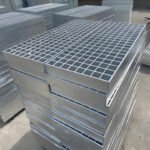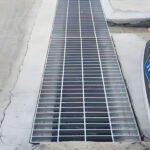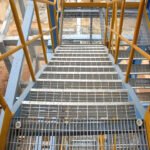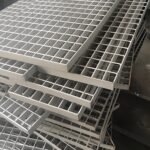


FRP (Fiberglass Reinforced Plastic) stair treads are made of fiberglass reinforcement and resin matrix (unsaturated polyester, vinyl ester, or phenolic) through a molding process. They are widely used in electroplating workshops, chemical plants, offshore platforms, wastewater treatment plants, and substations – where corrosion resistance and electrical insulation are critical. Compared to metal treads (steel, stainless steel, aluminum), FRP treads offer excellent chemical corrosion resistance (strong acids/alkalis), electrical insulation (non‑conductive), non‑magnetic properties, light weight (approx. 1/4 density of steel), flame retardancy, grit‑coated anti‑slip surface (friction coefficient ≥0.8), customizable colors, and maintenance‑free operation.
However, FRP has an elastic modulus about 1/20 of steel – deflection under the same load is much greater than metal. Therefore, the key to selecting FRP stair treads is: load class determines mesh size, span control is stricter than metal, resin type determines corrosion resistance, and grit coating is standard.
This article systematically explains resin type comparison, load class definitions, common specifications and load capacity, dimensional standards, anti-slip requirements, selection principles, and calculation examples for FRP stair treads.
1. FRP Material Grade Comparison (by Resin Type)
The corrosion resistance, temperature resistance, and long‑term creep behavior of FRP stair treads depend mainly on the resin type.
| Resin Type | Corrosion Resistance | Max Temp | Relative Strength | Suitable Load Scenarios | Typical Environment |
|---|---|---|---|---|---|
| Orthophthalic Polyester | Fair | ≤80°C | Baseline | Light loads | Indoor dry, mild corrosion |
| Isophthalic Polyester | Good | ≤90°C | 1.1x | Light‑medium loads | Wastewater, general chemical |
| Vinyl Ester | Excellent | ≤110°C | 1.2x | Medium to heavy loads | Electroplating, strong acids/alkalis, marine |
| Phenolic | Excellent (solvent resistant) | ≤150°C | 1.15x | Medium loads | High fire safety, high temperature |
Core recommendation: For most corrosive stair environments, isophthalic polyester is sufficient. For electroplating and strong acids/alkalis, use vinyl ester. For high fire safety, use phenolic. Vinyl ester has the lowest creep under long‑term load.
2. Load Classes – Determine Design Load from Application
FRP stair treads have approximately 1/4 to 1/3 the load capacity of steel treads – suitable for light to medium loads. Based on application, we divide FRP stair treads into four load classes:
| Load Class | Design Load (kN/m²) | Reference Load (t/m²) | Typical Application |
|---|---|---|---|
| Light | ≤ 1.0 | ≤ 0.10 | Personnel access ladders, indoor light ladders, laboratory stairs |
| Light-Medium | 1.0 – 1.8 | 0.10 – 0.18 | Wastewater treatment stairs, general industrial maintenance |
| Medium | 1.8 – 2.8 | 0.18 – 0.28 | Chemical plant operating ladders, electroplating stairs |
| Heavy | 2.8 – 4.0 | 0.28 – 0.40 | Offshore light ladders, light equipment stairs (closer supports required) |
Important: FRP stair treads are not recommended for forklift or heavy vehicle traffic (>4 kN/m²). For heavy loads, use stainless steel or hot-dip galvanized steel treads. For light hand trucks (total weight ≤150 kg), consider Light-Medium class.
3. Common Specifications & Load Capacity of FRP Stair Treads
3.1 Model Explanation
Common molded FRP stair tread model format: Mesh size (mm) × bar height (mm) + resin type + grit coating (optional)
- 25×25×25: mesh 25×25mm, bar height 25mm
- 38×38×25: mesh 38×38mm, bar height 25mm
- 38×38×30: mesh 38×38mm, bar height 30mm (most common)
- 38×38×38: mesh 38×38mm, bar height 38mm
- 50×50×50: mesh 50×50mm, bar height 50mm
3.2 Load-Span Table for FRP Stair Treads
Note: FRP has very low elastic modulus – recommended spans are much smaller than metal. The table below shows recommended maximum spans for common models under different loads (deflection control L/150 – stricter than metal). Data based on isophthalic polyester resin, grit-coated surface.
| Model | Mesh Size (mm) | Bar Height (mm) | Suitable Load Class | Recommended Max Span (by load) | Recommended Tread Width |
|---|---|---|---|---|---|
| 25×25×25 | 25×25 | 25 | Light (≤1.0 kN/m²) | 600 mm | 200-250 mm |
| 25×25×25 | 25×25 | 25 | Light-Medium (≤1.8 kN/m²) | 500 mm | 200-250 mm |
| 38×38×25 | 38×38 | 25 | Light-Medium (≤1.8 kN/m²) | 700 mm | 250-300 mm |
| 38×38×30 | 38×38 | 30 | Light-Medium (≤1.8 kN/m²) | 800 mm | 250-300 mm |
| 38×38×30 | 38×38 | 30 | Medium (≤2.8 kN/m²) | 650 mm | 250-300 mm |
| 38×38×38 | 38×38 | 38 | Medium (≤2.8 kN/m²) | 800 mm | 250-300 mm |
| 38×38×38 | 38×38 | 38 | Heavy (≤4.0 kN/m²) | 650 mm | 300-350 mm |
| 50×50×50 | 50×50 | 50 | Heavy (≤4.0 kN/m²) | 800 mm | 300-350 mm |
Important: Recommended deflection limit for FRP is L/150. The spans above are empirical values where deflection is approximately L/150. Always perform deflection verification for your specific project. For vinyl ester resin, data is similar; for phenolic, slightly lower.
4. Dimensional Standards for FRP Stair Treads
4.1 Tread Width (Depth)
| Stair Type | Recommended Width | Minimum Width | Notes |
|---|---|---|---|
| Indoor industrial FRP ladder | 200-250 mm | 180 mm | Personnel access |
| Outdoor/corrosive environment FRP ladder | 250-300 mm | 200 mm | Consider anti-slip and comfort |
| Offshore light ladder | 250-300 mm | 220 mm | Tool carrying |
Ergonomics recommendation: 250mm tread width is most comfortable.
4.2 Tread Length
Tread length is customized based on stair width. Common range: 600-1200 mm. Due to high FRP deflection, add intermediate supports or choose a higher‑capacity model for treads over 800mm.
4.3 Front Edge Treatment
Standard configuration: Grit coating extending to the edge, or a yellow warning area (no grit or yellow paint) projecting 20-30 mm below the tread. Stainless steel or FRP frames can be added for edge strength.
| Load Class | Edge Treatment | Yellow Warning | Frame Recommendation |
|---|---|---|---|
| Light | Full grit coating | Optional yellow nosing | Unframed |
| Light-Medium | Full grit coating | Recommended yellow nosing | Optional |
| Medium | Full grit coating | Mandatory yellow nosing | Recommended |
| Heavy | Full grit coating | Mandatory yellow nosing | Mandatory |
5. Anti-Slip Design Requirements (Safety First)
Anti-slip performance is the primary safety criterion for stair tread selection. Grit coating is standard.
| Anti-Slip Type | Structure | Friction Coefficient | Typical Application | Recommendation |
|---|---|---|---|---|
| Grit-coated (standard) | Quartz/alumina sand on surface | ≥0.8 | All industrial stairs, especially wet/oily/chemical | ★★★★★ Mandatory |
| Textured | Mold texture or mechanical sanding | 0.5-0.6 | Dry, mildly wet conditions | ★★ Not recommended for stairs |
| Smooth | As molded | 0.4-0.5 | Dry environments | ❌ Not recommended for stairs |
| Yellow warning nosing | Yellow grit or paint at front edge | ≥0.8 | Edge visibility | ★★★★★ Recommended for all stairs |
Standard configuration: Grit-coated surface + yellow warning nosing – meets safety requirements for most industrial stairs. OSHA requires static friction coefficient ≥0.5 for stair treads; grit-coated surface far exceeds this.
6. Core Selection Principles for FRP Stair Treads
Principle 1: Load class determines mesh size and bar height
- ≤1.0 kN/m² → 25×25×25
- 1.0 – 1.8 kN/m² → 38×38×25 or 38×38×30 (choose the latter for larger spans)
- 1.8 – 2.8 kN/m² → 38×38×30 or 38×38×38
- 2.8 – 4.0 kN/m² → 38×38×38 or 50×50×50
Principle 2: Deflection control is critical – spans must be smaller than metal
FRP has very low elastic modulus – recommended design deflection ≤ L/150. For the same load, FRP’s recommended span is about 1/2 to 1/3 of steel. Always verify deflection.
Principle 3: Resin type determines corrosion resistance and long-term performance
- Mild acids/alkalis, dry → Orthophthalic or Isophthalic polyester
- Strong acids, alkalis, oxidizing media → Vinyl ester
- Organic solvents, high temperature, fire safety → Phenolic
Principle 4: Grit-coated surface is mandatory
All FRP industrial stair treads must have a grit-coated surface unless the environment is absolutely dry with no slip risk. A yellow warning nosing is strongly recommended.
Principle 5: Installation method
- Bolted: Use stainless steel bolts with large diameter washers, torque 5-10 N·m (avoid crushing FRP)
- Clip fixation: Use FRP‑specific mounting clips
- When cutting, use a diamond blade, wear a dust mask, and seal cut edges with resin
7. Selection Calculation Examples
Example 1: Wastewater Treatment Plant Access Ladder
Parameters: Stair width 800mm, stringer span 650mm, personnel only, humid with mild corrosion.
Load: ≤1.0 kN/m² (Light)
Resin: Humid mild corrosion → Isophthalic polyester.
Selection: Light class recommends 25×25×25, max span 600mm < 650mm – not sufficient. Upgrade to 38×38×25 (Light-Medium), max span 700mm > 650mm – acceptable.
Tread width: Choose 250mm.
Anti-slip: Grit-coated + yellow nosing.
Recommendation: 38×38×25 isophthalic polyester grit-coated FRP stair tread, yellow nosing, stainless bolts.
Deflection estimate: Under 1.0 kN/m², span 650mm → deflection approx. L/180 ≈ 3.6mm < L/150=4.3mm – safe.
Example 2: Electroplating Workshop Operating Ladder
Parameters: Stair width 900mm, stringer span 700mm, personnel + small chemical drums (total ≤100 kg), strong acids, oxidizing media.
Load: Estimate 1.5 kN/m² (Light-Medium)
Resin: Strong acids, oxidizing → Vinyl ester.
Selection: Light-Medium class recommends 38×38×30, max span 800mm > 700mm – acceptable.
Tread width: Choose 280mm.
Anti-slip: Grit-coated + yellow nosing.
Frame: Recommend stainless steel frame for edge strength.
Recommendation: 38×38×30 vinyl ester grit-coated FRP stair tread with stainless steel frame, yellow nosing.
Deflection estimate: Under 1.5 kN/m², span 700mm → deflection approx. L/200 ≈ 3.5mm < L/150=4.7mm – safe.
Example 3: Offshore Platform Light Ladder
Parameters: Stair width 1000mm, stringer span 750mm, personnel + light tools, high salt spray, seawater splash.
Load: ≤1.0 kN/m² (Light)
Resin: Marine high salt spray → Vinyl ester (or phenolic if fire rating required).
Selection: Light class 38×38×25 max span 700mm < 750mm – not sufficient. Upgrade to 38×38×30 (Light-Medium), max span 800mm > 750mm – acceptable.
Tread width: Choose 250mm.
Anti-slip: Grit-coated + yellow nosing.
Frame: Mandatory stainless steel frame.
Recommendation: 38×38×30 vinyl ester grit-coated FRP stair tread with stainless steel frame, yellow nosing, stainless bolts.
Deflection estimate: Under 1.0 kN/m², span 750mm → deflection approx. L/190 ≈ 3.9mm < L/150=5.0mm – safe. Expected service life: over 30 years.
8. Common Selection Mistakes & How to Avoid Them
| ❌ Mistake | Consequence | ✅ Correct Practice |
|---|---|---|
| Using smooth or textured FRP treads (no grit) | Slip accidents | Must use grit-coated surface |
| Using metal tread span tables for FRP | Excessive deflection, bouncing, even breakage | Use FRP‑specific span table; control deflection to L/150 |
| Using orthophthalic resin in strong acid environment | Tread corrosion failure | Choose vinyl ester or phenolic based on media |
| Using FRP in heavy load areas (>4 kN/m²) | Tread breakage | Use steel or stainless steel for heavy loads |
| Not sealing cut edges | Fiber exposure, moisture absorption | Seal all cut edges with resin |
| Over-tightening bolts | FRP cracking | Torque 5-10 N·m, use large diameter washers |
| No yellow warning nosing | Poor edge visibility, trip hazard | Strongly recommend yellow nosing |
9. Quick Selection Table by Load Class
| Your Required Load | Recommended Resin | Recommended Model | Max Recommended Span | Example Applications |
|---|---|---|---|---|
| ≤1.0 kN/m² | Isophthalic | 38×38×25 | 700 mm | Wastewater stairs, indoor light ladders |
| 1.0 – 1.8 kN/m² | Isophthalic/Vinyl ester | 38×38×30 | 800 mm | General industrial maintenance, electroplating light |
| 1.8 – 2.8 kN/m² | Vinyl ester | 38×38×38 | 800 mm | Chemical plant operating, offshore ladders |
| 2.8 – 4.0 kN/m² | Vinyl ester/Phenolic | 50×50×50 | 800 mm | Light equipment stairs (verify) |
Span note: The maximum span in the table is 800mm because FRP is deflection‑sensitive. If your actual span is smaller, a lower model may work. If larger than 800mm, add more stringers or choose a higher‑capacity model and verify deflection.
10. Summary – Five‑Step Selection Method
- Identify corrosive media and environment → select resin type (Ortho/Iso/Vinyl/Phenolic)
- Determine load → from load class table (kN/m²)
- Measure stringer spacing → obtain actual span L (mm)
- Select from load-span table → ensure recommended span ≥ actual span, and verify deflection ≤ L/150
- Specify anti-slip and accessories → grit coating + yellow nosing (standard), optional frame/bolts/clips
If you already know your stair width, stringer spacing, and load but are still unsure which FRP model is best, please contact our engineers. We can provide a free deflection calculation sheet and resin selection recommendation.