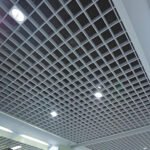


This guide outlines the standard method for installing our suspended aluminium grid ceiling systems, commonly specified in UK commercial and architectural projects.
Standard Installation Process (Summary)
- Benchmarking & Levelling: Establish a level datum line around the room perimeter using a laser level or water level.
- Fix Support Structure: Install fixing points into the structural ceiling. Suspend adjustable hanger wires or metal studs from these points.
- Fix Perimeter Trims: Secure aluminium perimeter angle trims to the walls at the pre-determined height.
- Pre-assemble Grid Modules: Lay out and connect the main and cross (tee) runners of the grid system on the floor in manageable sections.
- Lift & Secure Grid: Position the pre-assembled grid sections onto the perimeter trim. Securely fix the centre of the grid to the suspended support framework using wire or approved clips. Ensure the entire grid is level.
Detailed Step-by-Step Procedure
⑴ Marking Out & Setting Datum Lines
- Using a laser or optical level, transfer a consistent level point (typically +500mm or +1000mm above finished floor level) to all walls in the room.
- Mark this level around the entire perimeter. This is your Datum Line.
- From this datum line, measure up to calculate and mark the required suspended ceiling height.
- On the structural soffit (concrete ceiling), mark the planned locations for the primary support channels. These typically run parallel, spaced at centres of 900mm to 1200mm, and aligned according to the grid layout.
- ⑵ Installing the Primary Support & Hangers
- At the marked points on the structural soffit, fix expansion bolts or other approved anchors.
- Install threaded steel hanger rods (typically M6/M8) or proprietary metal channels from these anchors. For spans under 3 metres, a simplified perimeter-only support system may be sufficient.
- Ensure all hangers are vertical and securely fixed. The lower end of these hangers will later support the main support channels.
- ⑶ Fitting the Main Support Channels (Primary Runners)
- Suspend the main metal support channels (e.g., 38mm lightweight steel sections) from the hanger rods at the pre-set height.
- Space these primary runners at 900mm to 1200mm centres, parallel to each other.
- Crucial: The entire support framework must be levelled accurately. Use a string line or laser level across multiple points. For long spans (>15m), additional reinforcing channels may be required.
- ⑷ Installing Perimeter Trims
- Fix the aluminium wall angle trim around the entire room at the final ceiling height line, using suitable wall plugs and screws.
- This trim provides the perimeter support and a finished edge for the grid system.
- ⑸ Pre-assembling Grid Sections
- On a clean, flat area of the floor, connect the main runners and cross tees of the aluminium grid to form larger, manageable panels according to the planned layout.
- ⑹ Positioning & Final Fixing of the Grid
- Carefully lift the pre-assembled grid panels and place them onto the perimeter wall trim.
- The main runners of the grid should align with and be secured to the overhead primary support channels using fine galvanised wire or approved spring clips.
- Make final adjustments to ensure all grid intersections are aligned and the entire ceiling plane is perfectly level.
Important Note on Specifications & Pricing
- The density of the support structure (spacing of hangers and primary runners) is determined by the project’s design load and span requirements.
- As a general rule, a closer support spacing increases material and labour requirements, which will result in a higher installed cost. Our technical team can advise on the most cost-effective specification for your project.
- Professional Support for Your Project
- For full technical drawings, detailed load calculations, or site-specific installation advice, please contact our UK technical support team. We provide comprehensive support to ensure your aluminium ceiling project meets all building regulations and performance standards.