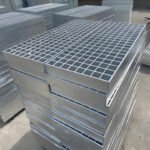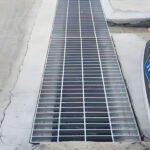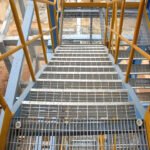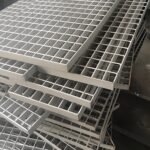


Aluminum stair treads are made of 6061-T6 or 6063-T5 aluminum alloy bearing bars and cross bars, joined by press‑locking (no welding). They are widely used in food processing plants, chemical plants, offshore platforms, wastewater treatment plants, and cleanrooms – where both light weight and corrosion resistance are required. Compared to steel treads, aluminum treads offer extremely light weight (approx. 1/3 of steel), natural corrosion resistance (no coating needed), non‑magnetic properties, easy handling, customizable surface colors, and 30‑year maintenance‑free service.
However, aluminum has an elastic modulus about 1/3 that of steel – deflection under the same load is about 3 times greater. Therefore, the key to selecting aluminum stair treads is: load class determines bar height, span control is stricter than steel, environment determines grade (6061/6063/5083).
This article systematically explains material grade comparison, load class definitions, dimensional standards, anti-slip requirements, selection principles, and calculation examples for aluminum stair treads.
1. Aluminum Material Grade Comparison (by Strength & Corrosion Resistance)
Common materials for aluminum stair treads are 6061-T6, 6063-T5, and 5083-H112. They differ in strength and corrosion resistance.
| Grade | Tensile (MPa) | Yield (MPa) | Corrosion Resistance | Characteristics | Typical Application | Surface Finish |
|---|---|---|---|---|---|---|
| 6061-T6 | ≥260 | ≥240 | Excellent | High strength, good load capacity, industrial grade | Food plants, chemical plants, general industry | Anodized/coated |
| 6063-T5 | ≥205 | ≥170 | Excellent | Good extrudability, smooth surface, decorative | Commercial buildings, indoor decorative stairs | Anodized/coated/wood grain |
| 5083-H112 | ≥290 | ≥215 | Superior (seawater resistant) | Marine grade, pitting resistant | Offshore platforms, coastal facilities, ship ladders | Anodized (thick) |
Selection advice: For general industrial and food environments, choose 6061-T6. For commercial aesthetics, choose 6063-T5. For coastal high salt spray, choose 5083.
2. Load Classes – Determine Design Load from Application
Aluminum stair treads have approximately 1/3 the load capacity of steel treads of the same size – suitable for light to medium loads. Based on application, we divide aluminum stair treads into four load classes:
| Load Class | Design Load (kN/m²) | Reference Load (t/m²) | Typical Application |
|---|---|---|---|
| Light | ≤ 1.5 | ≤ 0.15 | Personnel access ladders, indoor light ladders, commercial decorative stairs |
| Light-Medium | 1.5 – 2.5 | 0.15 – 0.25 | Food plant operating ladders, general maintenance, wastewater stairs |
| Medium | 2.5 – 3.5 | 0.25 – 0.35 | Chemical plant light ladders, offshore light ladders |
| Heavy | 3.5 – 5.0 | 0.35 – 0.50 | Light equipment ladders (closer supports required – not for frequent heavy loads) |
Important: Aluminum stair treads are not recommended for forklift or heavy truck traffic (>5 kN/m²). For heavy loads, use stainless steel or hot-dip galvanized steel treads. For light hand trucks (total weight ≤300 kg), consider Light-Medium class.
3. Common Specifications & Load Capacity of Aluminum Stair Treads
3.1 Model Explanation
Common stair tread model format: G (bar height × bar thickness) / bar pitch / cross bar pitch + F (serrated) + AL + grade
- G255/30/100F AL 6061: bar 25×5mm, pitch 30mm, cross bar pitch 100mm, serrated, 6061 grade
- G325/30/100F AL 6061: bar 32×5mm, pitch 30mm, cross bar pitch 100mm, serrated, 6061 grade
- G405/30/100F AL 6061: bar 40×5mm, pitch 30mm, cross bar pitch 100mm, serrated, 6061 grade
3.2 Load-Span Table for Aluminum Stair Treads
Note: Aluminum has low elastic modulus – recommended spans are significantly smaller than for steel treads. The table below shows recommended maximum spans for common models under different loads (deflection control L/150 – stricter than steel).
| Model | Bar Size | Suitable Load Class | Recommended Max Span (by load) | Recommended Tread Width |
|---|---|---|---|---|
| G255/30/100F | 25×5 | Light (≤1.5 kN/m²) | 1000 mm | 200-250 mm |
| G255/30/100F | 25×5 | Light-Medium (≤2.5 kN/m²) | 800 mm | 200-250 mm |
| G325/30/100F | 32×5 | Light-Medium (≤2.5 kN/m²) | 1000 mm | 250-300 mm |
| G325/30/100F | 32×5 | Medium (≤3.5 kN/m²) | 800 mm | 250-300 mm |
| G405/30/100F | 40×5 | Medium (≤3.5 kN/m²) | 1000 mm | 250-300 mm |
| G405/30/100F | 40×5 | Heavy (≤5.0 kN/m²) | 800 mm | 300-350 mm |
| G505/30/100F | 50×5 | Heavy (≤5.0 kN/m²) | 1000 mm | 300-350 mm |
Important: Aluminum deflection control should be stricter than steel – L/150 recommended. The spans above are empirical values where deflection is approximately L/150. Always perform deflection verification for your specific project.
4. Dimensional Standards for Aluminum Stair Treads
4.1 Tread Width (Depth)
| Stair Type | Recommended Width | Minimum Width | Notes |
|---|---|---|---|
| Indoor industrial aluminum ladder | 200-250 mm | 180 mm | Personnel access |
| Outdoor/food plant ladder | 250-300 mm | 200 mm | Consider anti-slip and comfort |
| Offshore light ladder | 250-300 mm | 220 mm | Tool carrying |
Ergonomics recommendation: 250mm tread width is most comfortable.
4.2 Tread Length
Tread length is customized based on stair width. Common range: 600-1200 mm. For aluminum treads over 1000mm, add intermediate supports due to higher deflection.
4.3 Front Nosing (Anti-Slip Plate)
Standard configuration: Aluminum checkered plate (4-5mm thick) or serrated bar nosing attached to the front edge, projecting 20-30 mm below the tread. Stainless steel bolts (mechanical fastening) are recommended – avoid welding (welding destroys the temper).
| Load Class | Nosing Thickness | Fixing Method | Surface Treatment |
|---|---|---|---|
| Light | 4 mm | Stainless bolts | Anodized/coated |
| Light-Medium | 4 mm | Stainless bolts | Anodized/coated |
| Medium | 5 mm | Stainless bolts | Anodized/coated |
| Heavy | 5 mm | Stainless bolts + reinforcement | Anodized/coated |
5. Anti-Slip Design Requirements (Safety First)
Anti-slip performance is the primary safety criterion for stair tread selection.
| Anti-Slip Type | Structure | Friction Coefficient | Typical Application | Recommendation |
|---|---|---|---|---|
| Serrated bars (F model) | Serrations rolled on bar surface | ≥0.6 | All industrial stairs, especially wet/food areas | ★★★★★ Mandatory |
| Aluminum checkered plate nosing | Checkered plate attached at front edge | ≥0.55 | Combined with serrated | ★★★★★ Standard |
| Plain bars | Smooth surface | 0.4-0.5 | Dry environments | ❌ Not recommended for stairs |
| Grit-coated | Sand adhered to surface | ≥0.8 | Extreme wet/icy conditions | ★★★ Optional |
Standard configuration: Serrated bars (F model) + aluminum checkered plate nosing – meets safety requirements for most industrial stairs.
6. Core Selection Principles for Aluminum Stair Treads
Principle 1: Load class determines bar height (but span is more sensitive)
- ≤1.5 kN/m² → bar height 25mm (G255/30/100F)
- 1.5 – 2.5 kN/m² → bar height 25mm or 32mm (G255 for span ≤800mm, G325 for larger)
- 2.5 – 3.5 kN/m² → bar height 32mm or 40mm (G325/G405)
- 3.5 – 5.0 kN/m² → bar height 40mm or 50mm (G405/G505)
Principle 2: Deflection control is stricter than steel
Aluminum has low elastic modulus – recommended design deflection ≤ L/150 (steel is L/200). For span 1000mm, deflection ≤6.7mm. Increase bar height or add supports if needed.
Principle 3: Corrosive environment determines grade
- Indoor dry, general industry → 6061-T6 (anodized)
- Food plants, humid environments → 6061-T6 (anodized or powder coated)
- Coastal, offshore platforms → 5083 (thick anodized)
- Commercial aesthetic → 6063-T5 (powder coated or wood grain)
Principle 4: Serrated bars are mandatory
All industrial stair treads should use serrated bars (suffix F) unless the environment is absolutely dry and free of oil/grease.
Principle 5: Front nosing is standard
An aluminum checkered plate nosing must be attached to the front edge for extra slip resistance and edge wear protection. Mechanical fastening with stainless steel bolts is recommended – avoid field welding.
Principle 6: Galvanic corrosion protection
When aluminum treads contact carbon steel stringers, use insulating washers (rubber or nylon). Fasteners must be stainless steel with nylon washers.
7. Selection Calculation Examples
Example 1: Food Plant Indoor Access Ladder
Parameters: Stair width 800mm, stringer span 900mm, personnel only, humid environment.
Load: ≤1.5 kN/m² (Light)
Material: Food plant humid → 6061-T6 aluminum, anodized.
Selection: From table, Light class recommends G255/30/100F, max span 1000mm > 900mm – acceptable.
Tread width: Choose 250mm.
Nosing: 4mm aluminum checkered plate, stainless bolts.
Recommendation: G255/30/100F AL 6061 stair tread, nosing, anodized.
Deflection estimate: Under 1.5 kN/m², span 900mm → deflection approx. L/180 ≈ 5mm < L/150=6mm – safe.
Example 2: Chemical Plant Light Operating Ladder
Parameters: Stair width 900mm, stringer span 1000mm, personnel + light hand truck (total ≤200 kg), mild acid vapor.
Load: Estimate 2.0 kN/m² (Light-Medium)
Material: Mild acid → 6061-T6 aluminum, thick anodized.
Selection: Light-Medium G255/30/100F max span 800mm < 1000mm – not sufficient. Upgrade to G325/30/100F, max span 1000mm – meets requirement.
Tread width: Choose 280mm.
Nosing: 5mm aluminum checkered plate, stainless bolts.
Recommendation: G325/30/100F AL 6061 stair tread with side plates for bolted connection, thick anodized.
Deflection estimate: Under 2.0 kN/m², span 1000mm → deflection approx. L/160 ≈ 6.3mm < L/150=6.7mm – acceptable.
Example 3: Offshore Platform Light Ladder
Parameters: Stair width 1000mm, stringer span 900mm, personnel + light tools, high salt spray.
Load: ≤1.5 kN/m² (Light)
Material: Marine high salt spray → 5083 aluminum, thick anodized.
Selection: Light class G255/30/100F max span 1000mm > 900mm – acceptable.
Tread width: Choose 250mm.
Nosing: 5mm aluminum checkered plate (5083), stainless bolts.
Recommendation: G255/30/100F AL 5083 stair tread, thick anodized. (If welding is required, use specialized TIG with 5356 filler and re‑heat treat; mechanical fastening preferred.)
Deflection estimate: ~L/200 – safe. Expected service life: over 30 years.
8. Common Selection Mistakes & How to Avoid Them
| ❌ Mistake | Consequence | ✅ Correct Practice |
|---|---|---|
| Using plain bars (non-serrated) | Slip accidents | Must use serrated bars (F model) |
| Using steel tread span tables for aluminum | Excessive deflection, bouncing feel | Use aluminum‑specific span table; control deflection to L/150 |
| Using aluminum in heavy load areas (>5 kN/m²) | Tread deformation, failure | Use steel or stainless steel for heavy loads |
| Field welding aluminum | Strength loss, distortion | Use mechanical fastening (bolts) |
| No front nosing | Edge wear, slip hazard | Must install checkered plate nosing |
| Direct contact between aluminum and carbon steel | Galvanic corrosion | Use insulating washers and stainless fasteners |
| Ignoring deflection verification | Unstable walking | Always verify deflection; add supports if needed |
9. Quick Selection Table by Load Class
| Your Required Load | Recommended Grade | Recommended Model | Max Recommended Span | Example Applications |
|---|---|---|---|---|
| ≤1.5 kN/m² | 6061/5083 | G255/30/100F | 1000 mm | Indoor maintenance, food plant, offshore light |
| 1.5 – 2.5 kN/m² | 6061 | G325/30/100F | 1000 mm | General industrial, chemical light |
| 2.5 – 3.5 kN/m² | 6061 | G405/30/100F | 1000 mm | Heavy light loads (verify) |
| 3.5 – 5.0 kN/m² | 6061 | G505/30/100F | 1000 mm | Use after verification – not for frequent heavy loads |
Span note: The maximum span in the table is 1000mm because aluminum is deflection‑sensitive. If your actual span is smaller, a lower bar height may work. If larger than 1000mm, add more stringers or choose taller bars and verify deflection.
10. Summary – Five‑Step Selection Method
- Identify application and corrosive media → choose grade (6061/6063/5083) and surface finish
- Determine design load → from load class table (kN/m²)
- Measure stringer spacing → obtain actual span L (mm)
- Select from load-span table → ensure recommended span ≥ actual span, and verify deflection ≤ L/150
- Specify nosing and accessories → nosing thickness by load, optional side plates/bolted connection, and galvanic corrosion protection measures
If you already know your stair width, stringer spacing, and load but are still unsure which aluminum model is best, please contact our engineers. We can provide a free deflection calculation sheet and CAD drawing to ensure a safe and economical selection.