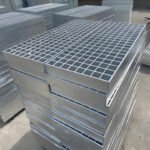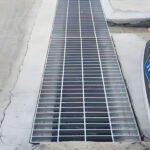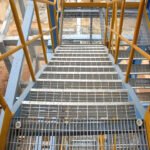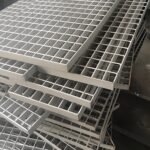


Hot-Dip Galvanized Stair Tread Load Classes & Selection Principles – Core of Safe Anti-Slip Step Selection
Hot-dip galvanized stair treads are the standard choice for industrial steel ladders, equipment maintenance platform stairs, and offshore platform stairways. Unlike standard platform grating, stair treads must meet three requirements: load capacity, anti-slip safety, and nosing protection. The key to selection is: load class determines bar height, span determines tread width, environment determines anti-slip level.
This article systematically explains load class definitions, dimensional standards, anti-slip requirements, selection principles, and calculation examples for hot-dip galvanized stair treads.
H2: 1. Load Classes – Determine Design Load from Application
Stair tread loads include personnel load and equipment/vehicle load. Based on application, we divide hot-dip galvanized stair treads into four load classes:
| Load Class | Design Load (kN/m²) | Reference Load (t/m²) | Typical Application |
|---|---|---|---|
| Light | ≤ 2.0 | ≤ 0.20 | Personnel access ladders, indoor steel ladders, general maintenance |
| Light-Medium | 2.0 – 3.5 | 0.20 – 0.35 | Workshop operating ladders, equipment maintenance platform stairs |
| Medium | 3.5 – 5.0 | 0.35 – 0.50 | Chemical plant operating ladders, heavy equipment access |
| Heavy | 5.0 – 8.0 | 0.50 – 0.80 | Offshore platform ladders, heavy load area stairs, forklift access |
Important: Stair tread design loads are typically uniform distributed loads. For forklift or heavy equipment traffic, also verify concentrated loads (e.g., forklift wheel loads). In such cases, choose taller bars or closer supports.
H2: 2. Common Specifications & Load Capacity of Hot-Dip Galvanized Stair Treads
2.1 Model Explanation
Common stair tread model format: G (bar height × bar thickness) / bar pitch / cross bar pitch + F (serrated)
- G255/30/100F: bar 25×5mm, pitch 30mm, cross bar pitch 100mm, serrated
- G325/30/100F: bar 32×5mm, pitch 30mm, cross bar pitch 100mm, serrated
- G405/30/100F: bar 40×5mm, pitch 30mm, cross bar pitch 100mm, serrated
2.2 Load-Span Table for Stair Treads
Stair tread span is the clear distance between stair stringers. The table below shows recommended maximum spans for common models under different loads (deflection control L/200, safety factor 2.0).
| Model | Bar Size | Suitable Load Class | Recommended Max Span (by load) | Recommended Tread Width |
|---|---|---|---|---|
| G255/30/100F | 25×5 | Light (≤2 kN/m²) | 1200 mm | 200-250 mm |
| G255/30/100F | 25×5 | Light-Medium (≤3.5 kN/m²) | 1000 mm | 200-250 mm |
| G325/30/100F | 32×5 | Light-Medium (≤3.5 kN/m²) | 1200 mm | 250-300 mm |
| G325/30/100F | 32×5 | Medium (≤5 kN/m²) | 1000 mm | 250-300 mm |
| G405/30/100F | 40×5 | Medium (≤5 kN/m²) | 1200 mm | 250-300 mm |
| G405/30/100F | 40×5 | Heavy (≤8 kN/m²) | 1000 mm | 300-350 mm |
| G505/30/100F | 50×5 | Heavy (≤8 kN/m²) | 1200 mm | 300-350 mm |
Important: Recommended spans for stair treads are generally stricter than for platform grating because stairs experience dynamic loads and impact. Perform deflection verification for actual projects.
H2: 3. Dimensional Standards for Hot-Dip Galvanized Stair Treads
3.1 Tread Width (Depth)
| Stair Type | Recommended Width | Minimum Width | Notes |
|---|---|---|---|
| Indoor industrial steel ladder | 200-250 mm | 180 mm | Personnel access |
| Outdoor industrial steel ladder | 250-300 mm | 200 mm | Consider anti-slip and comfort |
| Heavy equipment access ladder | 250-350 mm | 220 mm | Tool carrying |
Ergonomics recommendation: 250mm tread width is most comfortable.
3.2 Tread Length
Tread length is customized based on stair width. Common range: 600-1200 mm. For treads over 1200mm, add intermediate supports or choose taller bars.
3.3 Front Nosing (Anti-Slip Plate)
Standard configuration: Weld 4-6mm thick checkered plate (Q235B, diamond or teardrop pattern) to the front edge, projecting 20-30 mm below the tread.
| Load Class | Nosing Thickness | Welding Requirement |
|---|---|---|
| Light | 4 mm | Intermittent (50mm weld every 200mm) |
| Light-Medium | 4 mm | Intermittent |
| Medium | 5 mm | Full or reinforced intermittent |
| Heavy | 6 mm | Full weld |
H2: 4. Anti-Slip Design Requirements (Safety First)
Anti-slip performance is the primary safety criterion for stair tread selection.
| Anti-Slip Type | Structure | Friction Coefficient | Typical Application | Recommendation |
|---|---|---|---|---|
| Serrated bars (F model) | Serrations rolled on bar surface | ≥0.6 | All industrial stairs | ★★★★★ Mandatory |
| Checkered plate nosing | Checkered plate welded at front edge | ≥0.55 | Combined with serrated | ★★★★★ Standard |
| Plain bars | Smooth surface | 0.4-0.5 | Dry environments | ❌ Not recommended for stairs |
| Grit-coated | Sand adhered to surface | ≥0.8 | Extreme wet/icy conditions | ★★★ Optional |
Standard configuration: Serrated bars (F model) + checkered plate nosing – meets safety requirements for most industrial stairs. OSHA requires static friction coefficient ≥0.5 for stair treads.
H2: 5. Core Selection Principles for Hot-Dip Galvanized Stair Treads
Principle 1: Load class determines bar height
- ≤2 kN/m² → bar height 25mm (G255/30/100F)
- 2 – 3.5 kN/m² → bar height 25mm or 32mm (G255 for span ≤1000mm, G325 for larger)
- 3.5 – 5 kN/m² → bar height 32mm or 40mm (G325/G405)
- 5 – 8 kN/m² → bar height 40mm or 50mm (G405/G505)
Principle 2: Span determines tread width and bar height
- For the same load, larger span requires taller bars
- Tread width is not directly related to span, but wider treads require longer bars – control slenderness ratio
Principle 3: Serrated bars are mandatory
All industrial stair treads should use serrated bars (suffix F) unless the environment is absolutely dry and free of oil/grease.
Principle 4: Front nosing is standard
A checkered plate or serrated bar nosing must be welded to the front edge for extra slip resistance and edge wear protection.
Principle 5: Installation method affects safety
- Welded: Permanent stairs – most secure
- Bolted: Removable stairs – use stainless steel bolts
- After welding, grind welds and touch up with zinc-rich primer
H2: 6. Selection Calculation Examples
Example 1: Indoor Workshop Access Ladder
Parameters: Stair width 800mm, stringer span 1000mm, personnel only.
Load: ≤2 kN/m² (Light)
Selection: From table, Light class recommends G255/30/100F, max span 1200mm > 1000mm – acceptable.
Tread width: Choose 250mm.
Nosing thickness: 4mm checkered plate.
Recommendation: G255/30/100F hot-dip galvanized stair tread, 4mm nosing, welded to stringers.
Deflection estimate: ~L/250 – safe.
Example 2: Chemical Plant Operating Platform Stair
Parameters: Stair width 1000mm, stringer span 1100mm, personnel + small equipment (total ~500 kg).
Load: Estimate 3.5 kN/m² (between Light-Medium and Medium – treat as Medium).
Selection: Medium class recommends G325/30/100F, max span 1000mm < 1100mm? Check: G325 under 3.5-5 kN/m² has max span 1000mm – not sufficient. Upgrade to G405/30/100F, max span 1200mm > 1100mm – acceptable.
Tread width: Choose 280mm.
Nosing thickness: 5mm checkered plate.
Recommendation: G405/30/100F hot-dip galvanized stair tread with side plates for bolted connection (easy maintenance).
Deflection estimate: ~L/200 – acceptable.
Example 3: Offshore Platform Light Ladder
Parameters: Stair width 900mm, stringer span 1200mm, personnel + light tools (no vehicles). High salt spray environment.
Load: ≤2 kN/m² (Light)
Selection: Light class G255/30/100F max span 1200mm – just meets requirement. However, for marine environment, 316L stainless steel tread is recommended over hot-dip galvanized. If galvanized is used, specify thicker coating (≥85μm).
Tread width: Choose 250mm.
Nosing thickness: 5mm checkered plate.
Recommendation: G255/30/100F with thick HDG coating (≥85μm), welded.
Deflection estimate: ~L/240 – safe.
H2: 7. Common Selection Mistakes & How to Avoid Them
| ❌ Mistake | Consequence | ✅ Correct Practice |
|---|---|---|
| Using plain bars (non-serrated) | Slip accidents | Must use serrated bars (F model) |
| No front nosing | Edge wear, slip hazard | Weld checkered plate nosing |
| Span exceeds recommended value | Excessive deflection, unstable walking | Control span or increase bar height |
| Using 40mm pitch instead of 30mm | Reduced fall prevention and capacity | Stair treads must use 30mm pitch |
| No touch-up after welding | Rust at welds | Grind and apply zinc-rich primer |
| No bolt locking on side plates | Loose bolts, tread shifting | Use spring washers or lock nuts |
H2: 8. Quick Selection Table by Load Class
| Your Required Load | Recommended Model | Max Recommended Span | Example Applications |
|---|---|---|---|
| ≤2 kN/m² | G255/30/100F | 1200 mm | Indoor maintenance ladders, personnel access |
| 2 – 3.5 kN/m² | G325/30/100F | 1200 mm | Workshop operating ladders, general industrial |
| 3.5 – 5 kN/m² | G405/30/100F | 1200 mm | Chemical plant ladders, heavy equipment access |
| 5 – 8 kN/m² | G505/30/100F | 1200 mm | Offshore platform ladders, heavy load area stairs |
Span note: The maximum span in the table is 1200mm because stair stringer spacing is typically ≤1200mm. If your actual span is smaller, a lower bar height may work (e.g., G255 instead of G325). If larger, add more stringers.
H2: 9. Summary – Five‑Step Selection Method
- Identify the application → find design load (kN/m²) from load class table
- Measure stringer spacing → obtain actual span L (mm)
- Select from load-span table → ensure recommended span ≥ actual span
- Choose tread dimensions → width 250-300mm, length custom to stair width
- Specify nosing and accessories → nosing thickness by load, optional side plates/bolted connection
If you already know your stair width, stringer spacing, and load but are still unsure which model is best, please contact our engineers. We can provide a free load calculation sheet and CAD drawing to ensure a safe and economical selection.