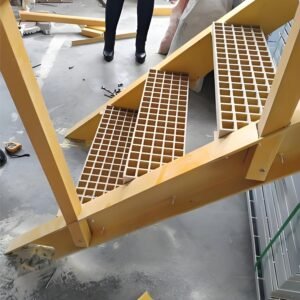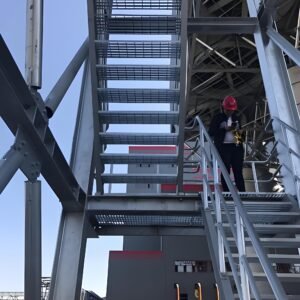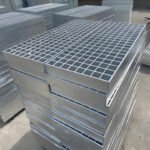

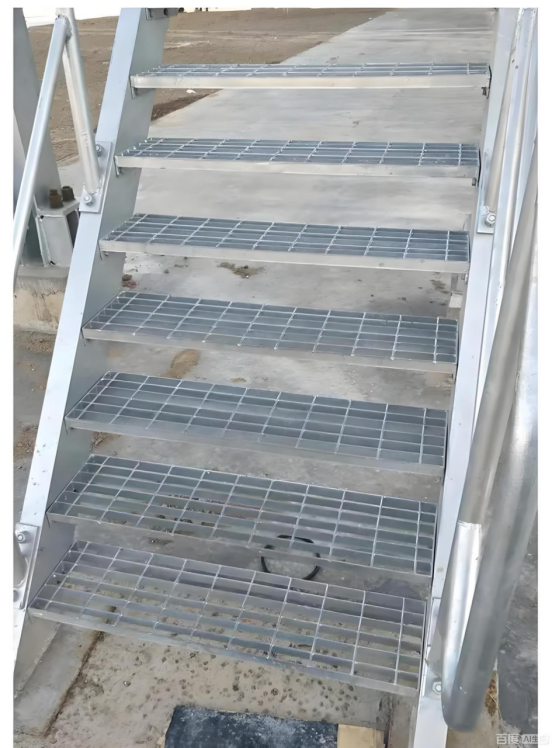
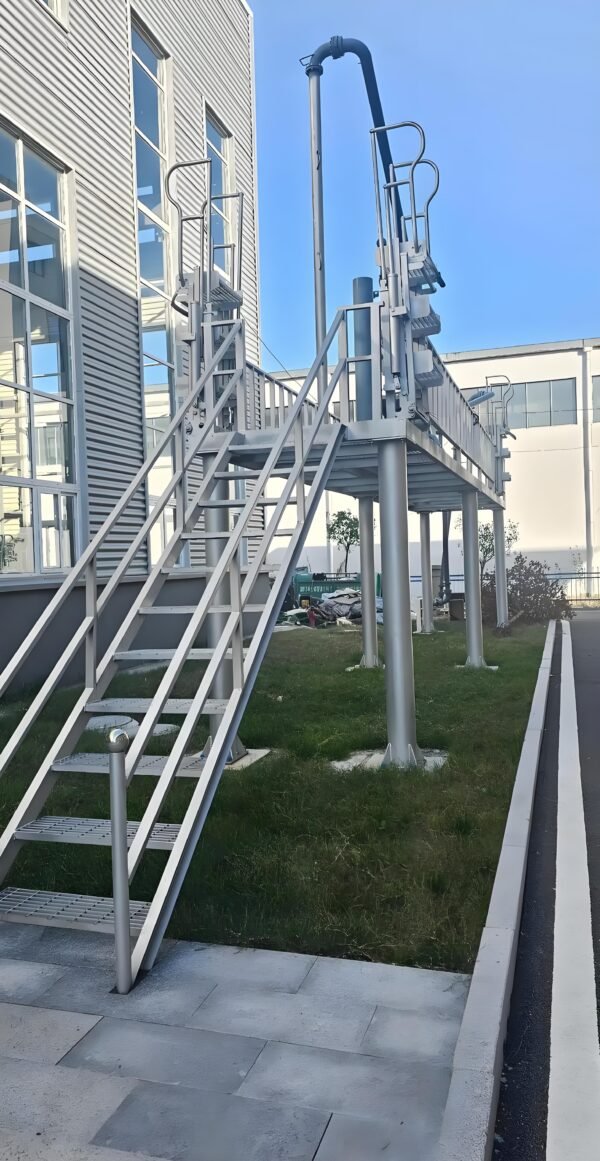
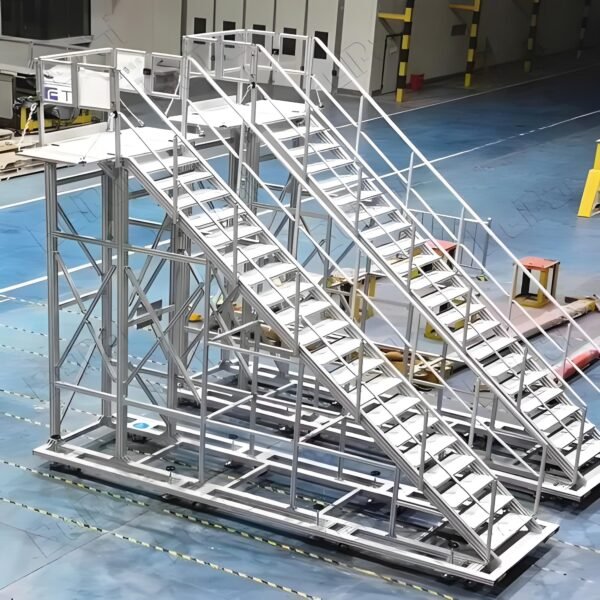
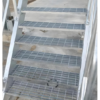
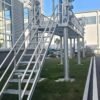
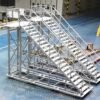
Aluminum Stair Tread – Lightweight & Corrosion‑Resistant Anti‑Slip Steps
Aluminum stair treads are made of 6061-T6 or 6063-T5 aluminum alloy bearing bars and cross bars, joined by press‑locking (no welding). They are widely used for food processing plant ladders, chemical plant access stairs, offshore platform stairways, wastewater treatment plant stairs, and cleanroom ladders – where both light weight and corrosion resistance are required. Compared to galvanized steel or stainless steel treads, aluminum stair treads offer extremely light weight (approx. 1/3 of steel), natural corrosion resistance (no coating needed), non‑magnetic properties, easy handling, customizable surface colors, and 30‑year maintenance‑free service.
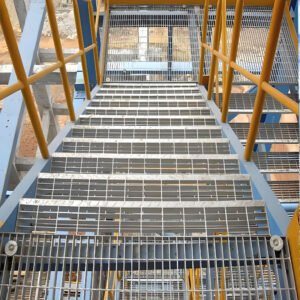
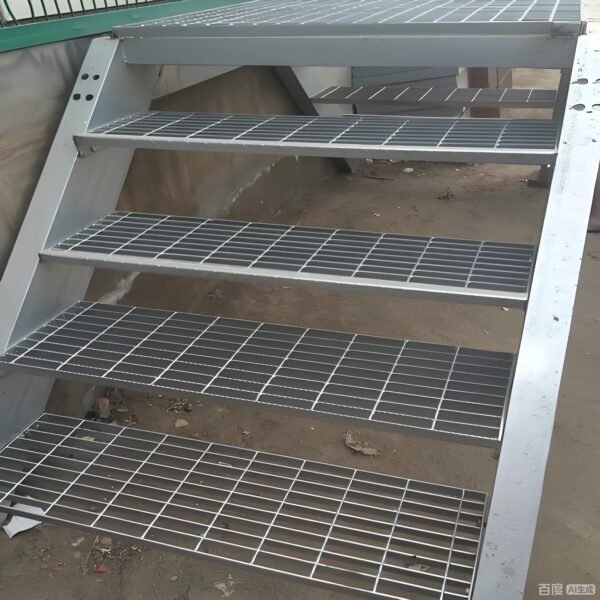
Aluminum stair treads are typically made of serrated models such as G255/30/100F and G325/30/100F, with bar heights of 25–32mm and bar pitch of 30mm. An aluminum slip‑resistant nosing (checkered plate or serrated bar) is attached to the front edge. Side plates can be added for bolted connections. Each tread is anodized (standard) or powder coated (optional) for enhanced corrosion resistance and appearance.
As a professional manufacturer of aluminum stair treads, we provide one‑stop service from material selection, load calculation, press‑locking forming, surface treatment to export. Below is a complete technical introduction.
1. Material Grade Comparison for Aluminum Stair Treads (by Strength & Corrosion Resistance)
The performance of aluminum stair treads depends on the alloy grade and temper. The table below lists the most common aluminum grades and a marine grade – choose according to your environmental corrosiveness and load requirements.
| Grade | Tensile (MPa) | Yield (MPa) | Corrosion Resistance | Characteristics | Suitable Application |
|---|---|---|---|---|---|
| 6061-T6 | ≥260 | ≥240 | Excellent | High strength, good workability, industrial grade | Food plants, chemical plants, general industry |
| 6063-T5 | ≥205 | ≥170 | Excellent | Good extrudability, smooth surface, decorative | Commercial buildings, indoor decorative stairs |
| 5083-H112 | ≥290 | ≥215 | Superior (seawater resistant) | Marine grade, pitting resistant | Offshore platforms, coastal facilities, ship ladders |
Recommendation: For most industrial corrosive environments, 6061-T6 is the best choice. For high aesthetics, choose 6063. For marine environments, choose 5083.
2. Load Classes & Selection Principles for Aluminum Stair Treads
The load capacity of aluminum stair treads is approximately 1/3 that of steel treads of the same size – pay attention to span vs. load when selecting. The table below lists common load classes and recommended models:
| Load Class | Reference Load | Typical Application | Recommended Grade/Model | Tread Width (mm) | Max Span |
|---|---|---|---|---|---|
| Light | ≤0.8 t/m² | Personnel access, indoor light ladders | 6063, G255/30/100F | 200–250 | ≤800mm |
| Light-Medium | 1–2 t/m² | Food plant access, general walkway stairs | 6061, G255/30/100F | 250–300 | ≤1000mm |
| Medium | 2–3 t/m² | Chemical plant stairs, wastewater stairs | 6061, G325/30/100F | 250–300 | ≤1200mm |
| Heavy | 3–4 t/m² | Light equipment stairs, offshore light duty | 5083, G405/40/100F | 300–350 | ≤1500mm (verify) |
Selection Principles:
-
Aluminum treads are not recommended for heavy truck or frequent heavy load areas – choose steel or stainless steel treads.
-
Bar height 25mm for light ladders; 32mm for most industrial stairs; 40mm+ for heavy duty (closer supports).
-
Serrated bars (suffix F) are standard – significantly better slip resistance than plain bars.
-
For corrosive environments, prioritize 6061-T6 or 5083; avoid 6063.
-
A slip‑resistant nosing (4–5mm aluminum checkered plate) is a standard safety feature.
3. Specification & Load Table for Aluminum Stair Treads
The table below lists the most common specifications for aluminum stair treads. All models can be custom-sized.
| Model | Bar Size (mm) | Bar Pitch (mm) | Cross Bar Pitch (mm) | Serrated | Nosing Thickness | Suitable Load | Typical Application |
|---|---|---|---|---|---|---|---|
| G255/30/100F AL | 25×5 | 30 | 100 | Yes | 4mm checkered | ≤1.5 t/m² | Food plant indoor, light access |
| G255/40/100F AL | 25×5 | 40 | 100 | Yes | 4mm checkered | 1–1.5 t/m² | General walkway stairs |
| G325/30/100F AL | 32×5 | 30 | 100 | Yes | 5mm checkered | 2–3 t/m² | Chemical plant, wastewater stairs |
| G325/40/100F AL | 32×5 | 40 | 100 | Yes | 5mm checkered | 1.5–2.5 t/m² | General corrosive industrial |
| G405/40/100F AL | 40×5 | 40 | 100 | Yes | 5mm checkered | 3–4 t/m² | Offshore light duty, heavy (closer supports) |
Specification Notes:
-
Bar material: 6061-T6 / 6063-T5 / 5083
-
Serrated bars: Periodic serrations rolled on surface, friction coefficient ≥0.6
-
Front nosing: Aluminum checkered plate (diamond pattern) or serrated flat bar
-
Side plates: Optional 6mm aluminum flat bar with bolt holes for bolted connection
-
Surface treatment: Anodizing (standard, film thickness ≥10μm), powder coating (RAL colors), mill finish/brushed
-
Applicable standards: GB/T 17888.3-2008, ISO 14122-3, OSHA 1910.24
4. Full Product Line of Aluminum Stair Treads
4.1 Standard Aluminum Stair Tread (with Front Nosing)
The most common type – serrated aluminum grating with a 4–5mm aluminum checkered plate nosing attached to the front edge. Suitable for most industrial aluminum ladders and maintenance platform stairs.
Common models: G255/30/100F AL, G325/30/100F AL
Features: Excellent slip resistance, durable nosing, uniformly anodized surface.
4.2 Aluminum Stair Tread with Side Plates (Bolted Type)
Aluminum flat bar side plates are attached to both ends of the tread, with pre‑drilled bolt holes for bolted connection to stair stringers. Ideal for stairs requiring disassembly or where field welding is not allowed. Side plates are mechanically fastened or TIG welded (re‑heat treat if welded).
Common models: G325/30/100F AL with side plates, G405/40/100F AL with side plates
Features: Easy installation and removal, no field welding, side plates add rigidity.
4.3 Fully Serrated Aluminum Stair Tread (without Nosing)
The tread is made entirely of serrated aluminum bearing bars – no additional checkered plate nosing. Suitable for stairs where maximum drainage and ventilation are needed, and a sealed edge is not required.
Common models: G325/30/100F AL (no nosing)
Features: Fully serrated, consistent slip resistance, open design, lighter weight.
4.4 Closed (Composite) Aluminum Stair Tread
A 2–4mm aluminum checkered plate or flat plate is laid on the grating surface, forming a solid tread. Suitable for preventing small tools from falling through, where a solid surface is required, or for high‑hygiene environments (e.g., food plants, laboratories).
Common models: HF-G325/30/100F AL composite tread
Features: Non‑perforated surface, drip‑proof, easy to clean, anodized.
4.5 Custom‑Shape Aluminum Stair Tread
Sector, trapezoidal, or curved treads for special stair designs (e.g., spiral stairs, corner landings). CNC cut, hydraulically curved, riveted or press‑locked from CAD drawings.
Applications: Sector stair landings, curved aluminum ladders, corner access stairs
5. Key Design Elements for Aluminum Stair Treads
5.1 Anti‑Slip Design (Safety First)
| Anti‑Slip Type | Structure | Friction Coefficient | Typical Application |
|---|---|---|---|
| Serrated bars | Periodic serrations on bar surface | ≥0.6 | Standard industrial stairs, oily/wet/food areas |
| Aluminum checkered plate nosing | 4–5mm checkered plate attached at front edge | ≥0.55 | Enhances front edge slip resistance |
| Grit‑coated | Sand adhered to surface | ≥0.8 | Extreme wet/icy conditions |
| Plain bars + anti‑slip strip | Welded round or flat bar | 0.4–0.5 | Dry conditions only – not recommended for stairs |
Standard configuration: Serrated bars + aluminum checkered plate nosing – meets safety requirements for most industrial stairs.
5.2 Stair Tread Dimensions
| Parameter | Recommended Value | Notes |
|---|---|---|
| Tread width (depth) | 200–300mm | 250mm is most comfortable (ergonomics) |
| Tread length | 600–1200mm | Custom based on stair width |
| Riser height | 150–200mm | Typically ~175mm, determined by stair design |
| Nosing overhang | 20–30mm | Should project ~25mm below tread |
5.3 Installation Methods
| Method | Operation | Typical Application |
|---|---|---|
| Mechanical (bolted) | Through side plates with stainless bolts | Recommended – removable |
| Welded | TIG with 5356 filler, re‑heat treat | Permanent (not recommended for field) |
| Inserted | Tread ends inserted into slotted stringers | Prefabricated stairs, quick installation |
Recommended method: Bolted connection. Aluminum welding destroys the temper – field welding is not recommended.
5.4 Load & Deflection Control
-
Design live load for stair treads: industrial ≥3 kN/m², general access ≥2.5 kN/m²
-
Maximum allowable deflection: span / 150 (aluminum has lower modulus – stricter control)
-
Recommended support span (stringer spacing) ≤1000mm (adjust based on load)
5.5 Front Nosing Details
-
Material: Aluminum checkered plate (6061-T6, diamond pattern)
-
Thickness: Light duty 4mm, medium 5mm
-
Attachment: Stainless steel countersunk bolts (recommended) or TIG welding (re‑heat treat)
-
Surface treatment: Anodized or powder coated together with tread body
5.6 Galvanic Corrosion Protection
When aluminum treads contact carbon steel stringers, use insulating washers (rubber or nylon). Fasteners must be stainless steel with nylon washers. Aluminum or stainless steel stringers are recommended.
6. Production Process of Aluminum Stair Treads
Our plant uses press‑locking (no welding for the main body) to ensure aluminum’s original strength and corrosion resistance are not compromised. The process is as follows:
1. Raw material inspection – MTC for aluminum bars and cross bars, grade verification (6061-T6/6063-T5/5083)
2. Slotting – Precision CNC slotting on bearing bars at designed pitch
3. Press‑locking – Cross bars pressed into slots using high‑tonnage hydraulic press
4. Cutting & hole punching – CNC cutting to required dimensions
5. Serrating – Roll serrations on bar surface (for serrated models)
6. Nosing/side plate assembly:
-
Nosing: Stainless steel bolts (recommended) or TIG welding (re‑heat treat if welded)
-
Side plates: Stainless steel bolts
7. Surface treatment:
-
Anodizing (standard): Electrochemical oxidation forms artificial oxide film (10–25μm) – improves corrosion resistance and hardness. Uniform matte silver grey finish.
-
Powder coating (optional): Electrostatic spray of polyester or fluorocarbon powder, heat cured – various RAL colors.
-
Mill finish / brushed (optional): Retains metallic luster.
8. Final inspection – Full visual inspection, dimensional check, oxide film thickness test, anti‑slip verification, bolt torque check
Quality commitment: Each batch includes material test certificate and anodizing thickness test report.
7. Installation & Fixing of Aluminum Stair Treads
Aluminum stair treads are lightweight (approx. 1/3 of steel), easy to install, but galvanic corrosion protection is critical.
7.1 Bolted Installation (Recommended)
-
Use M8–M12 stainless steel bolts (304 or 316L)
-
Bolt torque: 8–15 N·m (aluminum is soft – avoid over‑tightening)
-
Use stainless spring washers and nylon washers for isolation
-
Minimum 4 bolt connection points per tread
7.2 Welded Installation (Not Recommended for Field Use)
If unavoidable, use TIG welding with 5356 filler wire, then re‑solution treat and age to restore T6 temper. Generally not recommended for field installation.
7.3 Installation Notes
-
Bearing bar direction must be perpendicular to walking direction
-
Stringer spacing must not exceed design span
-
Levelness deviation per tread ≤3mm
-
Height difference between adjacent treads ≤5mm
-
Ensure the nosing faces upward after installation
-
Avoid direct contact between aluminum and carbon steel (use insulating washers)
-
Clean surface after installation; if iron contamination occurs, treat immediately
7.4 Acceptance Criteria
-
No warping or deformation
-
All bolts properly torqued, no looseness
-
Uniform anodized/coated finish, no scratches
-
Serrations clearly visible
-
No abnormal noise or wobbling during walk test
8. Typical Application Industries for Aluminum Stair Treads
| Industry | Recommended Grade/Model | Features | Key Requirements |
|---|---|---|---|
| Food & Beverage | 6061, G255/30/100F | Lightweight, non‑magnetic, detergent resistant, easy clean | Serrated, anodized |
| Chemical / Petrochemical | 6061, G325/30/100F | Mild acid/alkali resistance, non‑sparking, lightweight | Serrated + nosing, 6061 |
| Marine Engineering | 5083, G325/30/100F | Seawater pitting resistance, lightweight | 5083, thick anodizing |
| Wastewater Treatment | 6061, G255/30/100F | Humidity resistance, maintenance‑free | Press‑locked, serrated |
| Electronics / Semiconductor | 6061, closed or composite | Non‑magnetic, particle prevention, cleanroom | Non‑magnetic, ESD safe |
| Architectural / Commercial | 6063, G255/30/100F powder coated | Aesthetic, color options | Decorative, weather resistance |
| Pharmaceutical | 6061, composite + powder coating | Easy cleaning, no dead corners, disinfectant resistant | Composite sealed, flat |
9. Customization & Procurement Guide
As a direct manufacturer of aluminum stair treads, we offer comprehensive custom services:
-
✅ Material: 6061-T6, 6063-T5, 5083 (marine grade)
-
✅ Bar sizes: Height 25–50mm, thickness 5–6mm
-
✅ Grid spacing: Bar pitch 30/40mm, cross bar pitch 50/100mm
-
✅ Serrated: Standard (F model), plain optional
-
✅ Tread dimensions: Width 200–350mm, length 600–1500mm (from CAD drawings)
-
✅ Nosing: Aluminum checkered plate 4/5mm thick, or serrated bar nosing
-
✅ Side plates: Optional 6mm aluminum flat bar with bolt holes
-
✅ Surface treatment: Anodizing (standard), powder coating (RAL colors), mill finish/brushed
-
✅ Custom shapes: Sector, trapezoidal, curved treads
Packaging: Wooden pallet or plywood crate, with cardboard or foam separators between treads to prevent scratching.
Lead time: ≤500 pieces → 7–10 days; >1000 pieces → 15–20 days
Incoterms: FOB Tianjin/Shanghai/Ningbo, CIF major ports, or EXW factory