
FRP Grating Factory Direct | Molded & Pultruded Dual Process | Strong Acid & Alkali Resistant | Insulated & Flame Retardant | Chemical/Marine/Food Grade
Still frustrated by the rapid corrosion of chemical plant platforms? Worried that metal grating in electroplating workshops will fail within three years?
In corrosive environments, traditional metal grating—whether galvanized or painted—struggles to withstand continuous chemical attack. Frequent replacement is not only costly but also disrupts normal production.
FRP Grating—the composite material solution specifically engineered for corrosive environments.
With 18 years of expertise in composite material deep processing, we operate both molded and pultruded production lines, maintaining full industry chain control from resin formulation to finished product. From chemical plant operating platforms to offshore oil drilling platforms, from wastewater treatment plants to food processing facilities, we deliver extreme environment solutions featuring 50-year corrosion resistance, weight only 1/4 of steel, and lifetime maintenance-free performance.
What is FRP Grating?
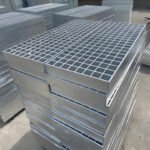
FRP (Fiberglass Reinforced Plastic) Grating, also known as fiberglass grating, is a composite material panel with regularly distributed rectangular or square openings. It is manufactured through molded or pultruded processes using unsaturated polyester resin (including orthophthalic, isophthalic, vinyl ester types) as the matrix and fiberglass continuous strand roving as reinforcement.
Its fundamental difference from metal grating lies in this: it is not made of metal, but composed of resin and fiberglass composites, delivering corrosion resistance and insulation properties that metal cannot match, while weighing only 1/4 of steel.
Eight Core Advantages of FRP Grating
✅ Exceptional Corrosion Resistance – 50 Years Without Rust
FRP grating offers outstanding resistance to acids, alkalis, organic solvents, salts, and numerous gaseous and liquid media—unparalleled superiority in the anti-corrosion field. Based on specific application requirements, different resin types can be economically selected as the matrix material:
| Resin Type | Application Scenarios | Corrosion Resistance Level |
| Orthophthalic | General corrosive environments, best cost-effectiveness | ⭐⭐⭐ |
| Isophthalic | Moderate corrosive environments, excellent all-round performance | ⭐⭐⭐⭐ |
| Vinyl Ester | Strong acids/alkalis, high temperature/humidity, offshore platforms | ⭐⭐⭐⭐⭐ |
Even in extreme environments such as chemical plants, electroplating facilities, or marine settings, FRP grating maintains a service life of over 50 years without requiring protective coatings—truly “install and forget.”
✅ Lightweight with High Strength – Only 1/4 Weight of Steel
FRP grating has a density of ≤2, just 1/4 of steel and 2/3 of aluminum. Yet its strength is 10 times that of rigid PVC, with absolute strength exceeding both aluminum and ordinary steel levels.
This lightweight, high-strength characteristic delivers multiple advantages:
Reduced structural burden: Significantly lowers requirements for supporting structures, saving foundation costs
No lifting equipment needed for installation: Manual handling and installation possible, increasing construction efficiency by over 50%
Ideal for mobile platforms: Lightweight and flexible, easy to disassemble and reconfigure
✅ Excellent Flame Retardancy – Safety Assured
FRP grating offers outstanding flame retardant properties, meeting stringent fire safety requirements:
Standard flame retardant type: Flame spread index (ASTM E-84) ≤ 25
Advanced flame retardant vinyl ester type: Flame spread index ≤ 10
Oxygen Index (OI): ≥ 28 (GB 8924)
Phenolic pultruded grating can achieve an OI of 100, with flame spread index as low as 5 and smoke density of 10—ideal for locations with extremely high fire protection requirements.
✅ Safe Insulation – No Breakdown at 10KV
FRP grating provides excellent electrical insulation, with no breakdown at 10KV voltage. Even when struck by tools, it generates no electrical sparks. It is also non-magnetic, suitable for use with magnetically sensitive equipment.
This characteristic makes it the ideal choice for explosive atmospheres, live working areas, substations, minesweepers, and other locations with special safety requirements.
✅ Slip Resistant & Anti-Fatigue – Personnel Safety Protected
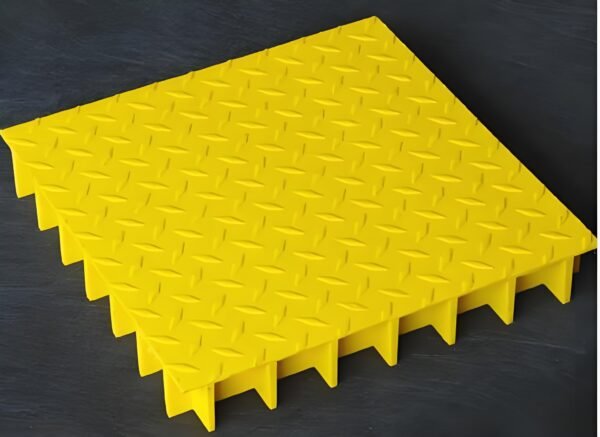
The special structure of FRP grating offers slip resistance and anti-fatigue properties. Various surface treatments are available—crescent surface, gritted surface, double-flat surface—providing high friction coefficients that maintain reliable grip even in wet or oily conditions.
More importantly, FRP grating possesses moderate elasticity, which can reduce leg and back fatigue for personnel working long hours on the surface, improving work efficiency.
✅ Aging Resistant – 85%+ Strength Retention After 20 Years
Manufactured with premium resins and anti-aging stabilizers, FRP grating has a service life exceeding 50 years. After atmospheric exposure, while appearance may change slightly, over 85% of strength remains after 20 years. It withstands the test of time, truly delivering lifetime maintenance-free performance.
✅ Consistent Color Throughout – Any Color Available
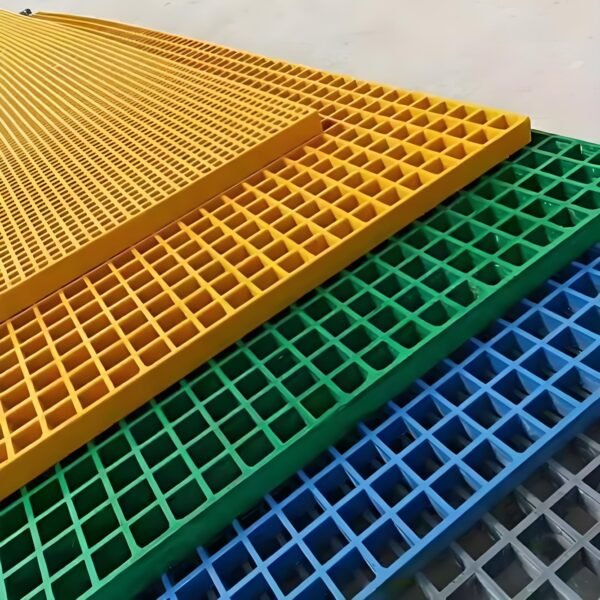
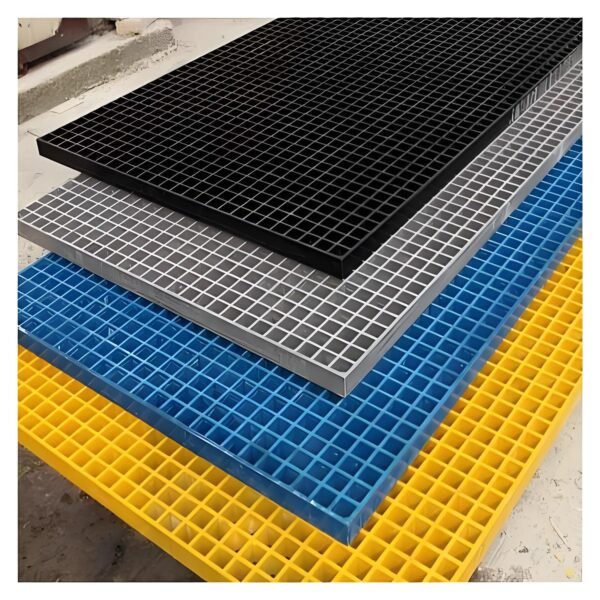
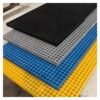
FRP grating color is achieved by blending pigment into the entire resin during production, resulting in uniform color throughout—never fading, requiring no painting. Colors can be customized according to customer requirements; common colors include yellow, black, gray, green, blue, red, etc.
Color serves not only aesthetic purposes but also safety warnings and zone demarcation, enhancing workplace environment and safety levels.
✅ High Design Flexibility – Easy On-Site Cutting
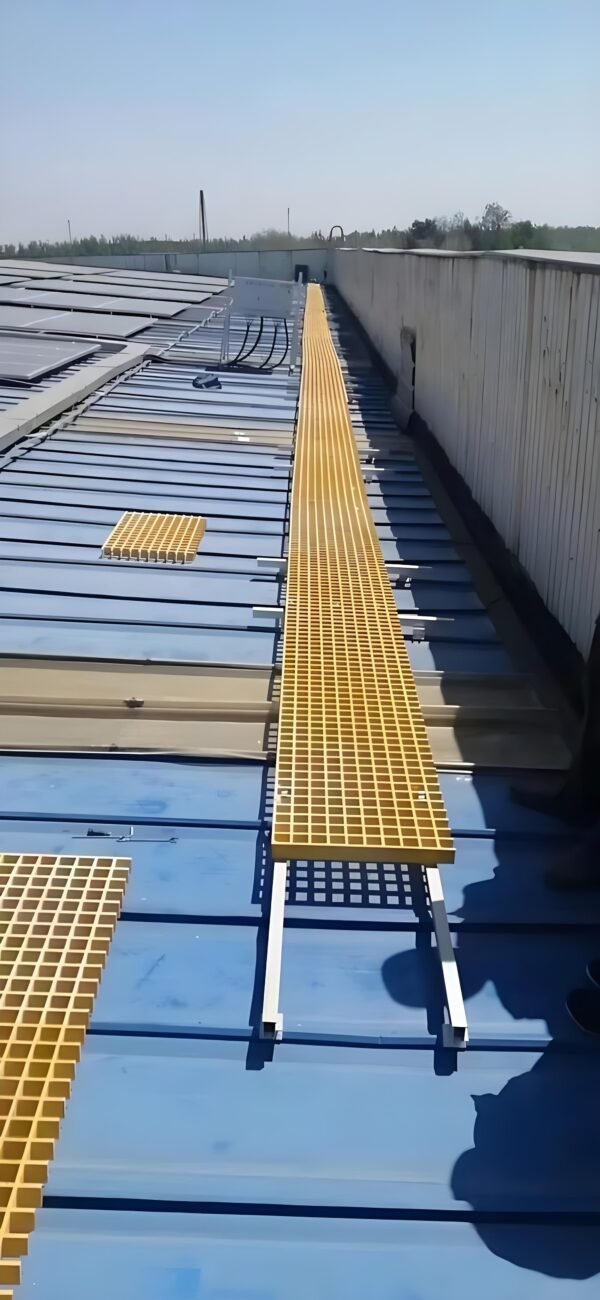
FRP grating offers dimensional stability and excellent design flexibility. On-site cutting and installation are remarkably simple—ordinary power tools with diamond blades can cut and drill. No hot work or heavy lifting equipment required; only minimal labor needed for installation, dramatically reducing installation costs.
Remarkably, cut pieces do not unravel like metal grating, maintaining structural integrity.
Two Process Series: Molded vs. Pultruded
Based on manufacturing process, FRP grating is divided into molded and pultruded types, each with distinct characteristics and applications:
| Comparison Item | Molded FRP Grating | Pultruded FRP Grating |
| Manufacturing Process | Fiberglass roving laid in metal mold, resin cast, cured in one operation | Fiberglass impregnated with resin, continuously pultruded through heated die, then assembled into grating |
| Structural Features | One-piece molded, isotropic mechanical properties | Assembled from load-bearing profiles (I-beam/T-beam) and connecting cross bars, strong unidirectional load capacity |
| Fiberglass Content | Approximately 30%-35% | >60%, higher unidirectional strength |
| Load Characteristics | Uniform bidirectional stress, excellent impact resistance | Outstanding large-span load capacity, greater stiffness |
| Corrosion Resistance | Thick resin-rich surface layer, superior corrosion resistance | Good corrosion resistance, slightly less than molded |
| Application Scenarios | Standard platforms, walkways, trench covers, stair treads | Large-span platforms, heavy-load walkways, bridges, applications requiring high stiffness |
Selection Recommendation: For bidirectional stress and ultimate corrosion resistance → Molded type; for large spans, heavy loads, high stiffness → Pultruded type.
Application Scenarios: Comprehensive Coverage from Chemical to Marine
Leveraging its exceptional corrosion resistance and lightweight high-strength characteristics, FRP grating has been widely adopted across various corrosive environments:
| Industry | Application Scenarios | Recommended Process |
| Petrochemical | Operating platforms, equipment platforms, maintenance walkways, drilling platforms, handrails | Molded/Pultruded |
| Wastewater Treatment | Maintenance walkways, trench covers, cooling tower platforms, biochemical tank hangers, trash racks | Molded |
| Electroplating/Printing & Dyeing | Electroplating line walkways, pickling workshops, dyeing tank flooring, raised access floors | Molded |
| Marine Engineering | Offshore oil platforms, ship decks, minesweepers, dock bridges | Pultruded/Molded |
| Power Industry | Chemical water treatment trench covers, substation walkways, wastewater pits | Molded |
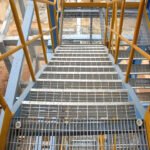
| Food/Pharmaceutical | Stair treads, operating platforms, slippery floors | Molded |
| Metallurgy/Paper | Pulp mill processing areas, metal surface treatment lines | Molded |
| Commercial Buildings | Plaza fountains, scaffolding, aquaculture fencing | Molded |
Detailed Application Examples:
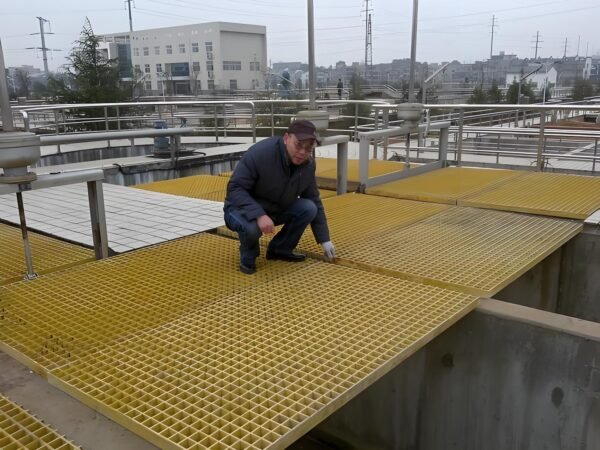
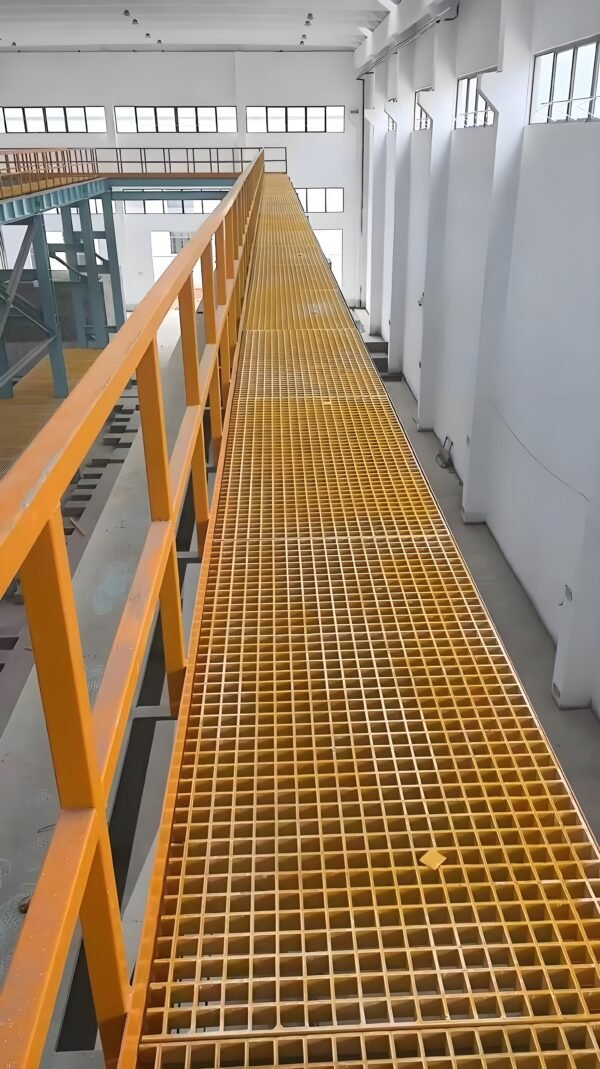
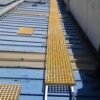
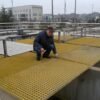
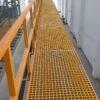
Chemical Plant Operating Platforms: Using FRP grating as flooring material provides corrosion resistance, requires no painting or maintenance, and achieves 15-20 years service life. Light weight eliminates need for lifting equipment during installation; cutting and drilling are easy without affecting mechanical properties.
Offshore Oil Platforms: Traditional steel plates corrode severely in harsh marine environments. After replacing with FRP grating, weight is reduced by 3/4, support structures become easier to handle, and corrosion protection is excellent—successfully proven in international applications.
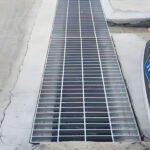
Wastewater Treatment Plant Trench Covers: Trenches often contain corrosive liquids. Traditional cast iron or cement covers deteriorate within months. FRP grating withstands long-term corrosion, allows wastewater to drain easily, and permits observation of trench conditions at any time.
Raised Floor Systems: Upper layer FRP grating, lower layer building substrate. Personnel walk and work on the upper level; waste liquids and solids drain to the lower level for easy washing and management.
Ship Decks: Reduces deck weight, increases cargo capacity, prevents seawater corrosion; non-magnetic特性 makes it suitable for minesweepers.
Specifications & Selection Guide
Common Thickness Options
| Thickness | Application Scenarios | Grid Size | Reference Weight |
| 25mm (1″) | Walkways, car wash platforms, light-duty walkways | 38×38mm | Approx. 52-75 kg/m² |
| 30mm (1.2″) | Standard industrial platforms, workstations | 25×25mm / 38×38mm | Approx. 75-84 kg/m² |
| 38mm (1.5″) | Wastewater plants, chemical plants, heavy-duty applications | 38×38mm | Approx. 85-92 kg/m² |
| 40mm (1.6″) | Heavy-duty industrial platforms | 40×40mm | Approx. 60 kg/m² |
| 50mm (2″) | Extra heavy-duty, vehicle traffic | 50×50mm | Approx. 100 kg/m² |
Note: Above are reference values; actual product may vary.
Standard Panel Sizes
| Process | Common Dimensions (L×W) | Notes |
| Molded | 1220×3660mm (4×12 feet) | Most common |
| Molded | 1007×3007mm | Regular stock |
| Molded | 1220×2440mm (4×8 feet) | Customizable |
| Pultruded | Custom length up to 7.3 meters | Suitable for large spans |
Surface Treatment Types
| Surface Type | Characteristics | Application Scenarios |
| Crescent Surface | Concave-convex texture, good slip resistance | General slip resistance requirements |
| Gritted Surface | Silicon carbide grit embedded, high friction | High slip resistance, ice/snow environments |
| Double-Flat Surface | Smooth top and bottom, high load capacity | Applications requiring high flatness |
| Covered Grating | Solid top surface on grating, fully enclosed | Prevent liquid dripping, tool dropping |
Color Options
FRP grating offers a wide range of colors. Common colors include: yellow, gray, green, blue, red, black, etc. Color can be used for:
Safety warnings: Yellow commonly used for Warning areas
Zone demarcation: Different colors distinguish functional areas
Aesthetic requirements: Harmonize with building environment
Performance Comparison: Pultruded FRP vs. Steel Grating
| Parameter | Pultruded FRP Grating (I38-6000) | Steel Grating |
| Weight | Approx. 13 kg/m² | Approx. 26 kg/m² |
| Tensile Strength | ≥300 MPa | 210 MPa |
| Flexural Strength | ≥350 MPa | 210 MPa |
| Corrosion Resistance | Never rusts, acid/alkali resistant | Not corrosion resistant, requires maintenance |
| Durability | 30 years | 15 years |
| Economy | Slightly higher initial investment, lifetime maintenance-free | Lower initial investment, annual maintenance |
| Transport/Installation | Low cost, quick installation | High cost, laborious installation |
| Service Temperature | Generally -40°C~60°C | Not suitable for low temperatures |
| Environmental Impact | Low pollution, low energy consumption | High pollution, high energy consumption |
Why Do Global Buyers Choose Us as Their Long-Term Supplier?
✅ Dual-Process Production Lines – One-Stop Solution
We operate both molded and pultruded complete production lines, enabling us to provide the most suitable solution based on your actual requirements. Whether standard platforms or large-span heavy-duty applications, we deliver precise matches.
✅ Full Industry Chain Control – Guaranteed Quality
Every step—from resin formulation and fiberglass selection to finished product—is strictly controlled. We maintain strategic partnerships with premium resin suppliers to ensure reliable raw material quality. All products undergo rigorous testing before shipment, complying with national standards such as GB/T 17955-2009.
✅ Rigorous Quality Inspection System
Barcol Hardness Test: Ensures hardness meets specifications
Flexural Strength Test: Evaluates resistance to bending failure
Flame Retardancy Test: OI ≥28, flame spread index compliant
Chemical Media Analysis: Tests corrosion resistance for different resin types
Dimensional Accuracy Control: Thickness deviation ≤1.6mm, water absorption ≤0.5%
✅ Participation in National Key Projects
Our FRP grating products have been applied in:
Large petrochemical enterprises: Thousands of square meters of operating platforms and walkways
Wastewater treatment plants: Comprehensive trench covers and maintenance walkways
Marine engineering projects: Offshore platforms and ship decks
Electroplating industrial parks: Walkway systems in centralized electroplating zones
Installation & Maintenance Guide
Installation Essentials
Cutting: Use handheld cutters or table saws with diamond blades; avoid ordinary blades (FRP is highly abrasive)
Support: Support the grating from below during cutting to prevent shifting and edge chipping
Fixing: Use stainless steel clamps or bolts; minimum 4 fixing points per square meter
Spacing: Leave 5-10mm gaps between panels to accommodate thermal expansion
Safety Protection: Wear goggles, masks, and gloves when cutting to prevent dust inhalation
Maintenance Essentials
No protective coatings needed: FRP grating is inherently corrosion resistant; no painting required
Easy cleaning: Can be washed with high-pressure water jets; self-cleaning properties
Periodic inspection: Check fixings for looseness; tighten promptly if found
Precautions
Avoid overloading: Strictly adhere to design loads
Avoid high temperatures: Long-term service temperature generally ≤ 60°C (special resins can withstand higher)
Avoid severe impact: Although impact-resistant, avoid violent impact
How to Select the Right FRP Grating for Your Project
Step 1: Determine Application Environment
Strong acids/alkalis, marine environment → Vinyl ester resin + Molded type
General corrosive environment, standard industrial → Isophthalic/Orthophthalic resin + Molded type
Large span, heavy load requirements → Pultruded type (I-profiles)
Step 2: Determine Load Requirements
Personnel traffic, light equipment → 25-30mm thickness
Standard industrial, forklift traffic → 38mm thickness
Heavy loads, vehicle traffic → 50mm thickness or pultruded type
Step 3: Determine Slip Resistance Level
General slip resistance → Crescent surface
High slip resistance, ice/snow environments → Gritted surface
Fully enclosed requirement → Covered grating
Step 4: Determine Color
Safety warning → Yellow
Aesthetic requirements → Choose according to environment
Step 5: Contact Us with Your Requirements
Provide your application environment, load requirements, and installation method.
Our technical team will deliver professional solutions and quotations within 24 hours.
Frequently Asked Questions
Q1: Which is better, FRP grating or steel grating?
A: There is no absolute “better”—it depends on the application scenario. In corrosive environments, FRP grating is far superior to steel—corrosion resistant, maintenance-free, lightweight, and insulated. However, in extremely high-temperature or high-impact situations, steel grating may be more suitable. We recommend the optimal solution based on your actual needs.
Q2: How long does FRP grating last?
A: Under normal conditions, over 50 years. After 20 years of atmospheric exposure, over 85% of strength remains.
Q3: Can vehicles drive on it?
A: Yes. 38mm thickness can accommodate standard industrial vehicle traffic; 50mm thickness or pultruded type can meet heavy vehicle requirements. Specific calculations depend on vehicle type and load.
Q4: Is it fire resistant?
A: Yes. Standard flame retardant type has OI ≥28; advanced types can reach OI 100, meeting stringent fire safety requirements.
Q5: Can it be cut on site?
A: Yes. It can be cut with ordinary power tools using diamond blades; cut pieces do not unravel.
[Get Your Custom FRP Grating Solution Today]
Stop worrying about metal corrosion. Stop wasting money on frequent replacements. Stop compromising on insulation safety.
Choosing our FRP grating means choosing 50 years of corrosion resistance, weight only 1/4 of steel, and lifetime maintenance-free peace of mind.
Click here to contact our engineers. Inquire today for free selection advice and material samples!