
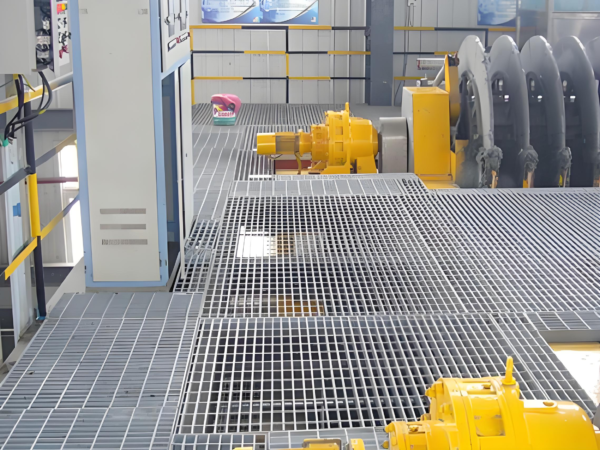
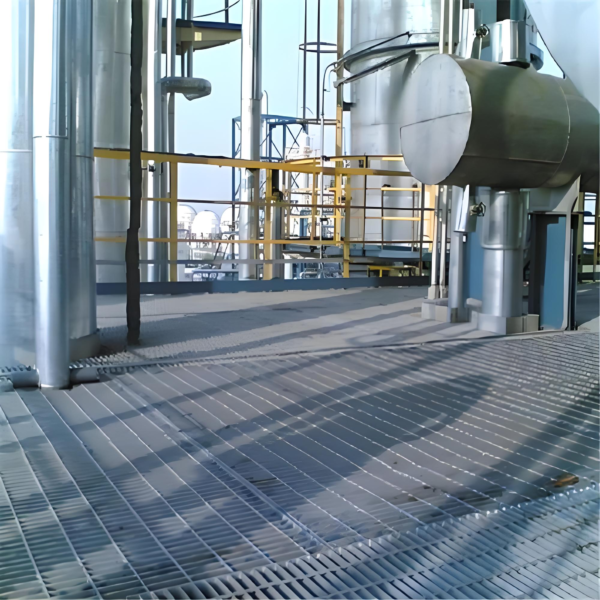
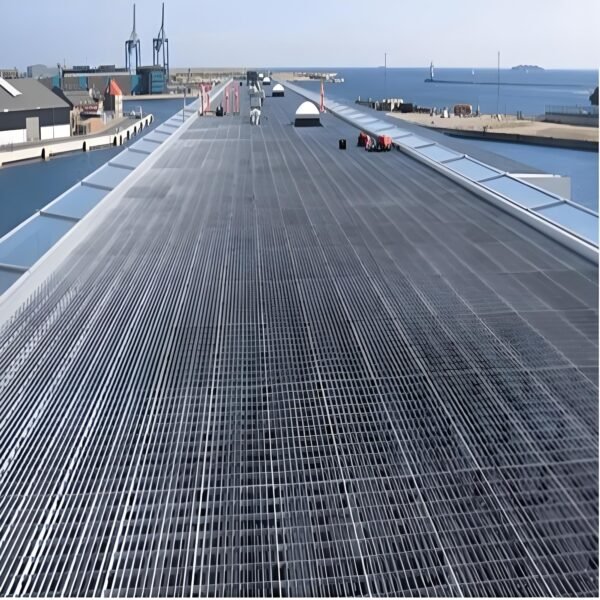
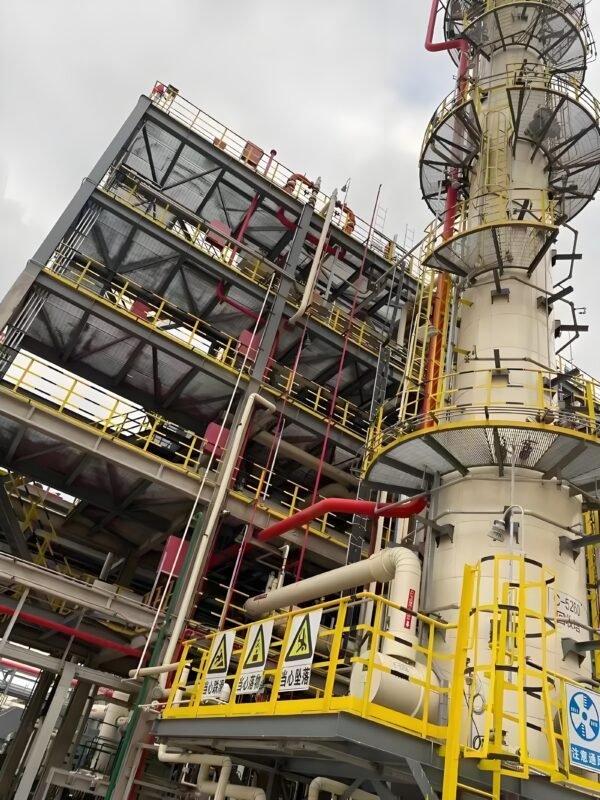
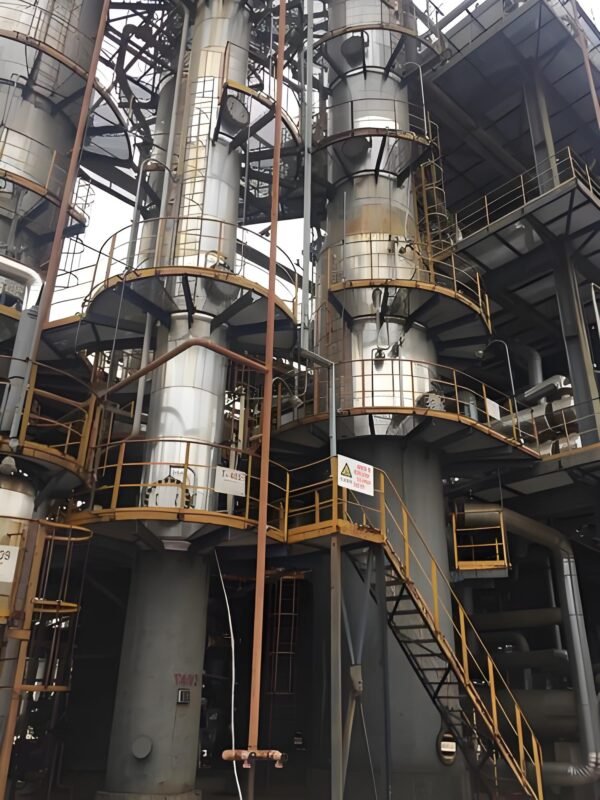
Stainless Steel Platform Grating – Safe Operating & Maintenance Platform Solutions for Corrosive Environments
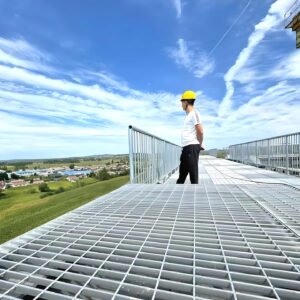
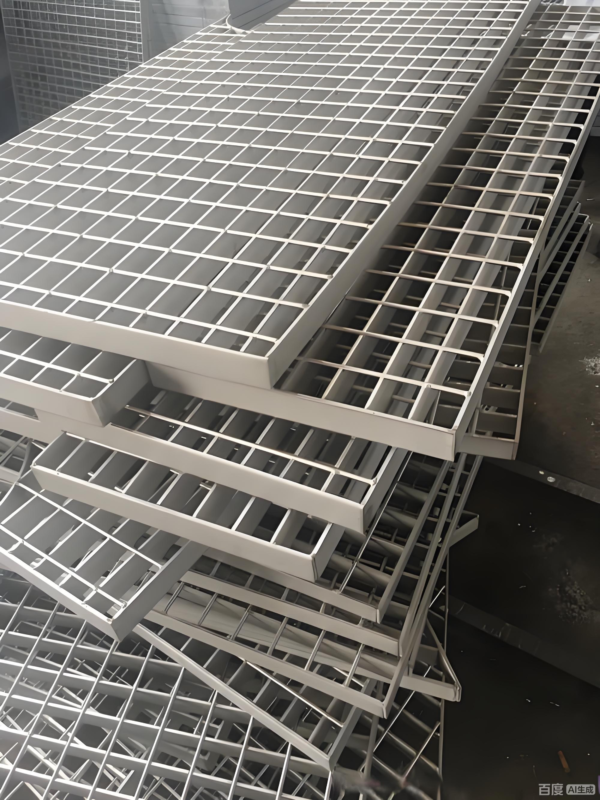
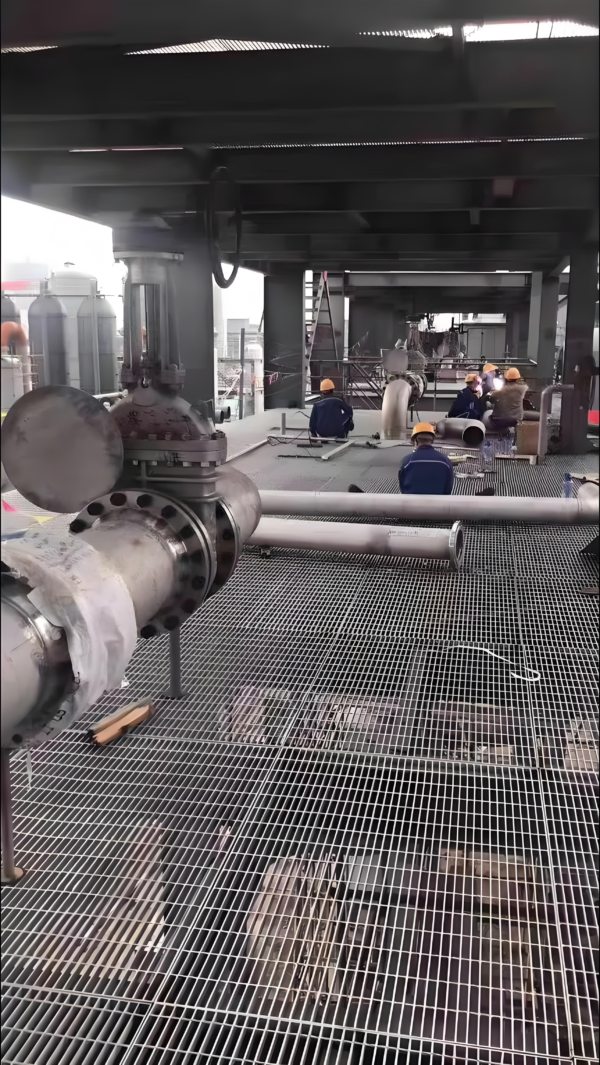
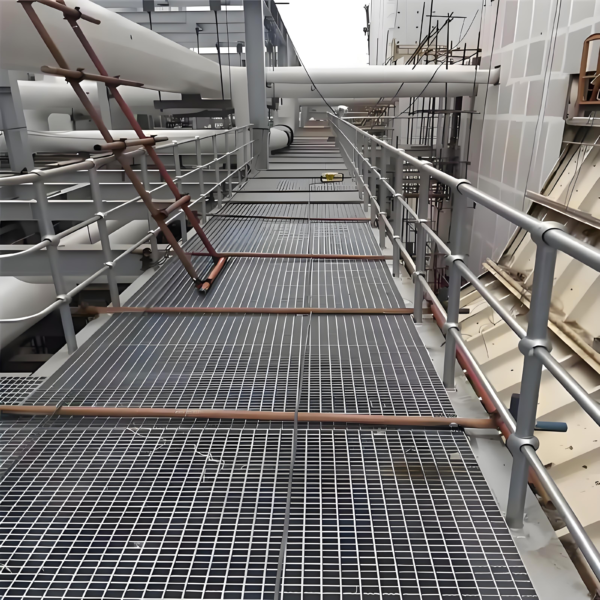
Stainless steel platform grating is manufactured from austenitic stainless steel bearing bars (grades 304, 304L, 316, 316L) and cross bars, joined by electric resistance welding or press‑locking, specifically designed for industrial operating platforms, equipment maintenance platforms, tank top platforms, and similar applications. Unlike hot-dip galvanized platform grating, stainless steel platform grating relies on its inherent chromium content (≥10.5%) to form a dense passive film. It requires no additional coating and remains rust‑free and corrosion‑free for decades in extreme environments such as strong acids, alkalis, high salt spray, and high humidity.
Stainless steel platform grating offers high load capacity, 100% corrosion resistance, anti‑slip safety, easy cleaning, and hygienic properties. It is widely used in chemical, marine, pharmaceutical, food, wastewater treatment, and electronics cleanroom platform applications where corrosion resistance is critical.
As a professional manufacturer of stainless steel platform grating, we provide one‑stop service from material selection, load calculation, welding forming, surface treatment (pickling & passivation / polishing) to export. Below is a complete technical introduction.
1. Material Grade Comparison for Stainless Steel Platform Grating (by Corrosion Resistance & Strength)
The corrosion resistance and strength of stainless steel platform grating depend mainly on the material grade. The table below lists the four most common stainless steel grades – choose according to your environmental corrosiveness and load requirements.
| Grade | Cr% | Ni% | Mo% | Tensile (MPa) | Yield (MPa) | Characteristics | Suitable Platform Environment |
|---|---|---|---|---|---|---|---|
| 304 | 18-20 | 8-10.5 | – | ≥515 | ≥205 | General corrosion resistance, cost‑effective | Food platforms, indoor maintenance, fresh water |
| 304L | 18-20 | 8-12 | – | ≥485 | ≥170 | Low carbon, better intergranular corrosion resistance after welding | Platform structures with many welds |
| 316 | 16-18 | 10-14 | 2-3 | ≥515 | ≥205 | Molybdenum added, chloride & seawater resistant | Offshore platforms, chemical plants, brine |
| 316L | 16-18 | 10-14 | 2-3 | ≥485 | ≥170 | Low carbon + molybdenum, best performance after welding | Seawater immersion platforms, pharmaceutical cleanrooms, strong corrosive |
Recommendation: For most corrosive environment platforms, 316L is the best choice; for food and general industrial platforms, 304 is sufficient.
2. Load Classes & Selection Principles for Stainless Steel Platform Grating
The load capacity of stainless steel platform grating is similar to carbon steel, but the elastic modulus is slightly lower (approx. 193GPa vs 200GPa for carbon steel). Allow a safety margin when selecting. The table below lists common load classes and recommended models:
| Load Class | Reference Load | Typical Platform Scenario | Recommended Grade/Model | Max Recommended Span |
|---|---|---|---|---|
| Light | ≤2 t/m² | Personnel inspection, light maintenance | 304, G203/30/100, G255/40/100 | 1000mm |
| Medium | 3–5 t/m² | Personnel + light equipment, pharmaceutical operation | 304L/316L, G325/30/100 | 1200mm |
| Heavy | 5–8 t/m² | Chemical plant operation, offshore equipment | 316L, G405/30/100, G405/40/100 | 1500mm |
| Extra Heavy | 8–12 t/m² | Heavy machinery base, port platform | 316L, G505/30/100 | 1800mm |
Selection Principles:
-
Every 10mm increase in bar height increases load capacity by approx. 30–40%
-
For corrosive environments, prioritize 316L to avoid pitting
-
Recommended platform design deflection ≤1/200 of span
-
For welded platform grating, use low‑carbon grades (304L/316L) to prevent intergranular corrosion
3. Specification & Load Table for Stainless Steel Platform Grating
The table below lists the most common specifications for stainless steel platform grating. All models can be customized.
| Model | Bar Size (mm) | Bar Pitch (mm) | Cross Bar Pitch (mm) | Unit Weight (kg/m²) | Suitable Load | Typical Platform Type |
|---|---|---|---|---|---|---|
| G203/30/100 SS304 | 20×3 | 30 | 100 | 28 | ≤2 t/m² | Food plant walkway maintenance platform |
| G255/40/100 SS304 | 25×5 | 40 | 100 | 40 | 3–4 t/m² | Pharmaceutical operating platform, equipment access |
| G325/30/100 SS316L | 32×5 | 30 | 100 | 55 | 5–7 t/m² | Chemical plant platform, seawater pump room platform |
| G325/40/100 SS316L | 32×5 | 40 | 100 | 48 | 4–6 t/m² | Wastewater treatment platform, general industrial |
| G405/30/100 SS316L | 40×5 | 30 | 100 | 70 | 7–9 t/m² | Offshore platform, heavy equipment maintenance |
| G405/40/100 SS304 | 40×5 | 40 | 100 | 60 | 6–8 t/m² | Food heavy platform, port platform |
| G505/30/100 SS316L | 50×5 | 30 | 100 | 85 | 9–12 t/m² | Offshore drilling platform, heavy load areas |
Specification Notes:
-
Bar heights: 20mm, 25mm, 32mm, 40mm, 50mm, 65mm (custom available)
-
Bar thickness: 3mm, 4mm, 5mm, 6mm, 8mm
-
Bar surface: Plain flat bar (standard), serrated (anti‑slip)
-
Cross bars: 6×6mm twisted square bars, pitch 50mm or 100mm
-
Surface treatment: Pickling & passivation (standard) or mechanical polishing
4. Full Product Line of Stainless Steel Platform Grating
4.1 Standard Industrial Stainless Steel Platform Grating
Made of 304 or 316L, bar height 32–40mm, pitch 30–40mm. Suitable for most operating platforms, maintenance platforms, and tank top platforms in corrosive environments. Edges can be banded with stainless steel border for increased rigidity.
Common models: G325/30/100 SS316L, G405/40/100 SS304
Features: Excellent overall performance, most widely used, uniform pickled & passivated surface.
Applications: Chemical reactor operating platforms, desalination plant maintenance platforms, pharmaceutical cleanroom operating platforms
4.2 Heavy-Duty Stainless Steel Platform Grating
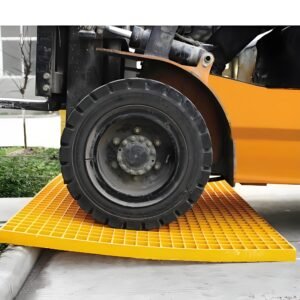
Made of 316L, bar height 40–50mm, pitch 30mm. Designed for heavy equipment installation, forklift traffic, offshore platform decks, and other heavy‑duty corrosive environments.
Common models: G405/30/100 SS316L, G505/30/100 SS316L
Features: Extremely high load capacity, dense bar pitch (30mm), excellent impact resistance.
Applications: Offshore drilling platforms, port loading platforms, heavy chemical equipment maintenance platforms
4.3 Serrated Anti‑Slip Stainless Steel Platform Grating
Platform surface uses serrated bearing bars (suffix F, e.g., G325/30/100F SS316L), increasing slip resistance by over 30%. Ideal for wet, oily, icy, or pharmaceutical residue‑contaminated platform environments.
Common models: G325/30/100F SS316L, G405/40/100F SS316L, G255/30/100F SS304
Features: Friction coefficient ≥0.6, slip resistance class R13, meets OSHA safety requirements.
Applications: Offshore platform decks, chemical tank farm platforms, meat processing plant operating platforms, wash‑down room platforms
4.4 Composite Stainless Steel Platform Grating
A 3–5mm thick stainless steel checkered plate or flat plate is laid on the platform grating, joined by welding or press‑locking, then pickled and passivated as one assembly. Suitable for preventing small parts from falling, liquid drips, and clean platforms requiring a sealed surface.
Common models: HF-G325/30/100 SS316L composite platform, HF-G405/40/100 SS304 composite platform
Features: Non‑perforated surface prevents chemical drips; easy to wash and sanitize, meeting GMP/HACCP requirements; fully corrosion‑resistant with no coating peeling risk.
Applications: Pharmaceutical cleanroom operating platforms, chemical repackaging platforms, laboratory workstations, electronics factory ESD‑safe platforms
4.5 Custom‑Shape Stainless Steel Platform Grating
Non‑rectangular platforms such as circles, sectors, rings, trapezoids – CNC cut, bent, TIG welded, and pickled & passivated as a whole. Welds are bright, and the heat‑affected zone is passivated to restore corrosion resistance.
Common shapes: Sector platforms (corners), circular platforms (towers), ring platforms (tank tops), trapezoidal platforms (around equipment)
Applications: Circular tower operating platforms, sector stair landings, tank top ring maintenance platforms, oval equipment enclosure platforms
5. Key Design Elements for Stainless Steel Platform Grating
5.1 Platform Edges & Border Treatment
-
Welded border: Weld stainless steel channel or angle steel around the perimeter for increased rigidity, preventing edge curling. Filler metal matches base material (308L for 304, 316L for 316L).
-
Toe plate: Install stainless steel toe plates (height ≥100mm) around platform edges to prevent tool falls. Toe plates are also pickled & passivated.
-
Safety nosing: Weld anti‑slip nosing at platform opening edges for personnel safety.
5.2 Platform Cutouts & Equipment Pass‑Through
-
Round holes: For equipment piping – custom diameters, with stainless steel reinforced border around holes.
-
Square/rectangular openings: For personnel access or equipment hoisting – install stainless steel safety railings around openings.
-
Removable covers: Large openings with hinged stainless steel grating covers, with hinges and lift handles for easy maintenance access.
5.3 Platform Support Structure
-
Support beam spacing: Typically ≤1200mm (adjust based on load)
-
Bearing bar direction: Must be perpendicular to support beams
-
Support bearing length: ≥25mm at each end
-
Support beam material: Stainless steel or coated carbon steel recommended (use insulating washers to prevent galvanic corrosion)
5.4 Platform Anti‑Slip Requirements
-
Standard platform: Plain flat bars + pickled & passivated surface (friction coefficient approx. 0.5)
-
Wet/oily/pharmaceutical platforms: Serrated bars (friction coefficient ≥0.6)
-
Inclined platforms (>10°): Serrated bars mandatory, bar pitch ≤30mm
-
Food/pharmaceutical clean platforms: Composite type + mirror polish optional
5.5 Galvanic Corrosion Protection
When stainless steel platform grating contacts carbon steel support structures, insulating washers (rubber or plastic) must be used to prevent galvanic corrosion. Fasteners should be stainless steel.
6. Production Process of Stainless Steel Platform Grating
Our plant strictly follows the process below to ensure every product meets export standards and cleanliness requirements:
1. Raw material inspection – MTC for stainless steel bars and cross bars, grade verification (304/316L)
2. Automatic welding – Fully automatic resistance welding line, weld penetration ≥2mm, with inert gas shielding. For 316L, welding heat input is strictly controlled to prevent carbide precipitation.
3. Leveling & straightening – Hydraulic leveling ensures flatness ≤3mm/m
4. Cutting & hole punching – Plasma/laser cutting, CNC hole punching, accuracy ±1mm
5. Edge finishing – Welded border, edge banding, toe plates, etc. (TIG welding, matching filler)
6. Surface treatment (critical step) :
-
Pickling & passivation (standard): Immersion or spray of passivation paste/liquid – removes scale and chromium‑depleted layer in the weld heat‑affected zone, reforms a dense passive film. Surface becomes uniform matte silver white.
-
Mechanical polishing (optional): Progressive sanding/buffing to mirror finish (400#–600#) for pharmaceutical, electronics, and other clean platforms.
7. Final inspection:
-
Full visual inspection (no weld spatter, no heat tint)
-
Dimensional accuracy check
-
Passivation film test (blue dot test – report provided per batch)
-
Flatness check
Quality commitment: Each batch includes material test certificate and passivation test report. Third‑party inspection (SGS/BV/TÜV) available.
7. Installation & Fixing of Stainless Steel Platform Grating
7.1 Welding Fixation (Permanent Platform)
-
Use TIG welding with filler metal matching base material (308L for 304, 316L for 316L)
-
Tack weld or full weld platform grating to support beams around perimeter
-
Grind welds and re‑passivate weld areas
7.2 Stainless Steel Mounting Clip Fixation (Removable Platform)
-
Use M‑type, C‑type or G‑type stainless steel mounting clips in 304 or 316
-
Minimum 4 clips per platform panel (one at each corner)
-
Clip bolt torque: 15–25 N·m (stainless is softer, avoid over‑tightening)
7.3 Bolted Fixation (Heavy Platform)
-
Use stainless steel bolts and hold‑down plates
-
Add nylon washers between bolts and grating to prevent scratching
7.4 Installation Notes
-
Bearing bars must be perpendicular to support beams
-
Support beam spacing must not exceed design value
-
Leave 5–10mm thermal expansion gaps between panels
-
Stainless steel toe plates (height ≥100mm) must be installed around platform edges
-
Avoid direct contact with carbon steel – use insulating washers
-
Clean surface after installation; if iron contamination occurs, treat with stainless steel cleaner
8. Typical Application Industries for Stainless Steel Platform Grating
| Industry | Recommended Grade/Model | Platform Characteristics | Key Requirements |
|---|---|---|---|
| Petrochemical | 316L, G325/30/100F serrated | Strong acid resistance, anti‑slip, explosion‑proof | Serrated, heavy duty, solvent resistant |
| Marine Engineering | 316L, G405/30/100 thick bars | Seawater resistance, salt spray, heavy load | 316L, pickled & passivated, thick bars |
| Pharmaceutical | 316L, composite + mirror polish | No dead corners, sterilizable, GMP compliant | Composite sealed, mirror finish, detergent resistant |
| Food & Beverage | 304, closed, serrated or composite | Hygiene, easy cleaning, acid/alkali detergent resistant | Non‑magnetic, good drainage |
| Wastewater Treatment | 304 or 316L, G325/40/100 | Humidity resistance, microbial corrosion resistance | Fully welded, anti‑slip |
| Electronics / Semiconductor | 304, closed or composite | Particle prevention, cleanroom grade | Non‑magnetic, ESD safe |
| Seawater Desalination | 316L, G325/30/100 | Chloride resistance, high‑temperature brine resistance | 316L, pickled & passivated |
9. Customization & Procurement Guide
As a direct manufacturer of stainless steel platform grating, we offer comprehensive custom services:
-
✅ Material: 304, 304L, 316, 316L, 321, Duplex 2205 (on request)
-
✅ Bearing bar sizes: Height 20–100mm, thickness 3–10mm, any combination
-
✅ Grid spacing: Bar pitch 15/30/40/60mm, cross bar pitch 50/100mm
-
✅ Surface treatment: Pickling & passivation (standard), mechanical polishing (brushed/mirror), sandblasting
-
✅ Edge finishing: Welded border (stainless channel/angle/flat bar), toe plates, safety nosing
-
✅ Cutout customization: Round holes, square holes, slots – from CAD drawings, reinforced edges
-
✅ Custom shapes: Sector, circle, trapezoid, ring, etc., from CAD drawings
-
✅ Accessories: Stainless steel mounting clips, bolts, hinges, insulating washers, handrail posts
Load calculation service: We provide stainless steel platform grating load‑span tables and deflection verification.
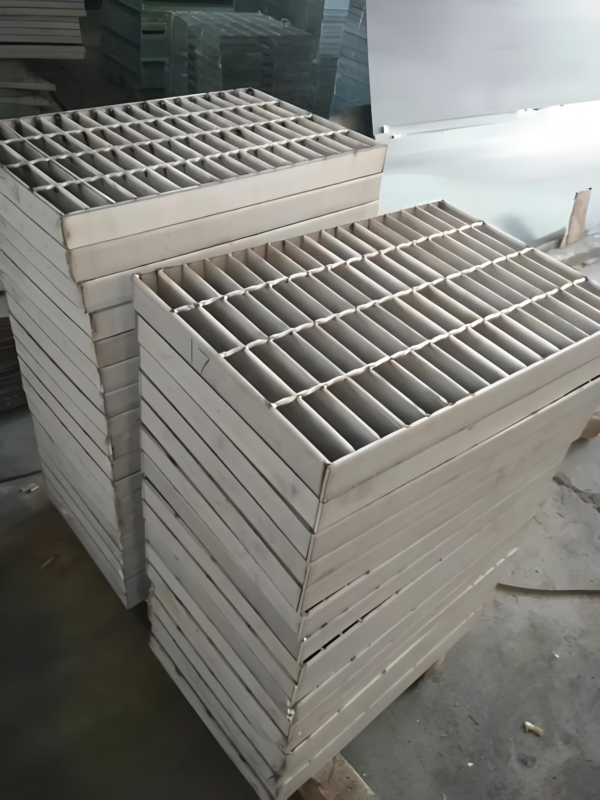
Packaging: Wooden pallet or plywood crate, with cardboard or foam separators between stainless steel panels to prevent scratching.
Lead time: ≤500㎡ → 7–10 days; >1000㎡ → 15–20 days
Incoterms: FOB Tianjin/Shanghai/Ningbo, CIF major ports, or EXW factory