
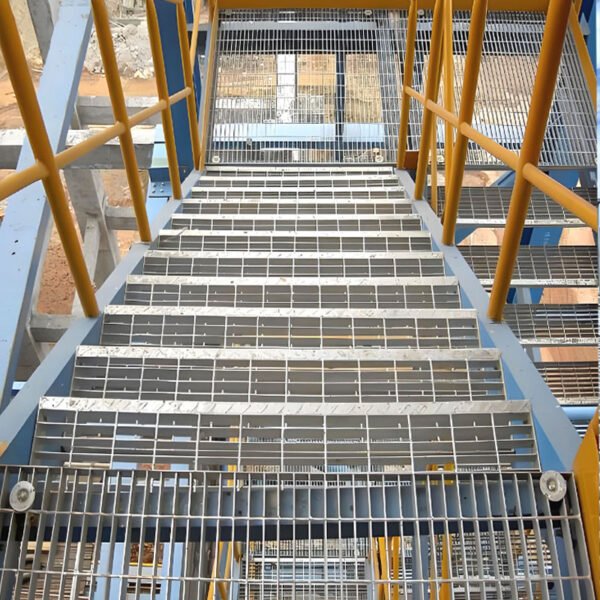
Stair Tread & Platform Grating Factory Direct | Serrated Anti-Slip/Patterned Steel Nosing | T1-T4 Full Series | Industrial/Commercial/Public Facility Stairs
In damp industrial workshops, does watching workers climb stairs make you break out in a cold sweat? In crowded shopping malls, does the risk of customers slipping keep you up at night?
Ordinary steel grating used directly as treads lacks edge protection and sufficient slip resistance—creating significant safety hazards.
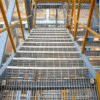
Stair Tread & Platform Grating—the deep-processed product specifically engineered for stair safety.
With 20 years of expertise in steel grating deep processing, we operate fully automated serrated bar production lines and tread-dedicated welding assembly lines. From chemical plant maintenance ladders to shopping mall atrium landscape stairs, from offshore platform gangways to subway station evacuation stairs, we deliver professional stair solutions featuring slip resistance coefficient ≥0.6, uniform load capacity ≥3kN/m², and 30 years of safety with zero maintenance.
What is Stair Tread & Platform Grating?
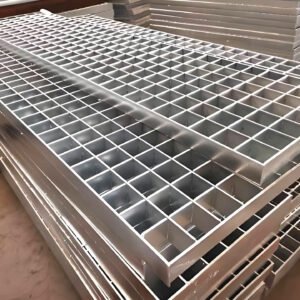
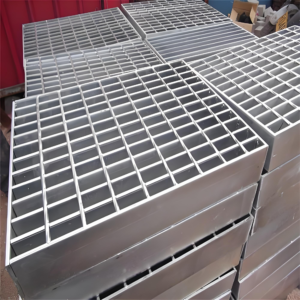
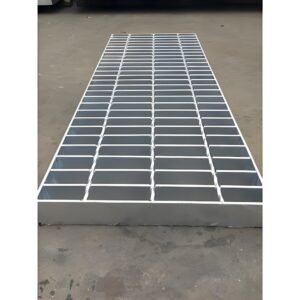
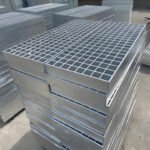
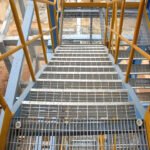
Stair tread and platform grating, also known as stair treads or step treads, are stair-specific components manufactured from steel grating. They are deep-processed products typically formed by welding bearing bars and cross bars into a base panel, then adding anti-slip strips, side plates, and front nosing plates.
The fundamental difference from ordinary steel grating lies in this: treads are “finished products”—ready for immediate installation upon arrival; while ordinary steel grating is a “semi-finished product” requiring on-site cutting, edge banding, and anti-slip treatment.
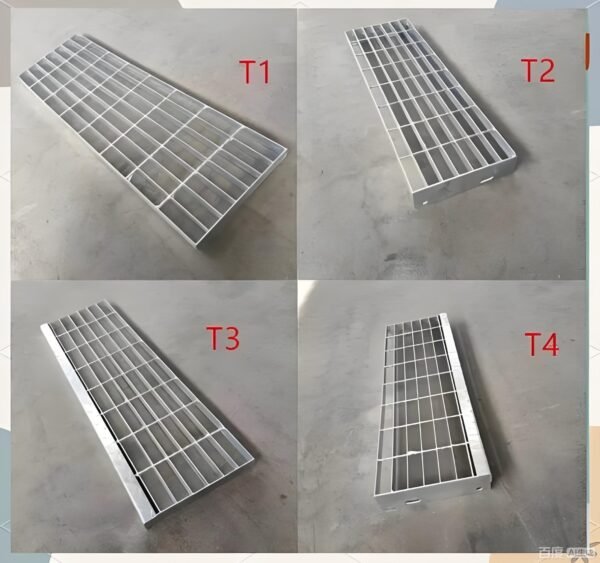
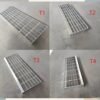
Based on installation method and structural configuration, treads are classified into four standard types: T1, T2, T3, and T4:
T1/T3: Welded fixing—directly welded to stair stringers—economical and durable
T2/T4: Bolt fixing—detachable and reusable—suitable for locations requiring maintenance
T1/T2: Without front nosing—suitable for applications with general slip resistance requirements
T3/T4: With front nosing—enhanced edge slip resistance and warning—higher safety
Four Core Advantages of Stair Tread Grating
✅ Extreme Slip Resistance – Friction Coefficient ≥0.6
Treads utilize serrated bearing bars (models with “S” designation) as the load-bearing element, featuring 1.5-2mm deep serrated grooves on the surface. This serrated structure effectively disrupts the continuity of water and oil films, creating powerful mechanical interlocking between footwear and the tread surface. Even in wet or oily environments, the friction coefficient remains stable at ≥0.6 (compliant with GB 24537-2009 standard).
Select models also incorporate patterned steel front nosing, further enhancing slip resistance at the tread edge.
✅ High Load Capacity – Uniform Load ≥3kN/m²
Manufactured from high-strength carbon steel (Q235B/Q355B) , treads achieve uniform loads of 3-10kN/m² depending on bar specifications and spacing, with ultimate load capacities reaching 10-15kN. Compared to concrete treads, weight is reduced by 50%-70%, while significantly lowering requirements for supporting structures.
Recommended Load Spans by Specification:
| Bar Section | Series 1 Max Length | Series 2 Max Length | Series 3 Max Length |
| 25×3mm | 550mm | 450mm | — |
| 25×5mm | 900mm | 750mm | 550mm |
| 32×5mm | 1300mm | 1200mm | 850mm |
| 40×5mm | 1600mm | 1500mm | 1350mm |
✅ Water Permeability & Drainage – Open Area ≥60%
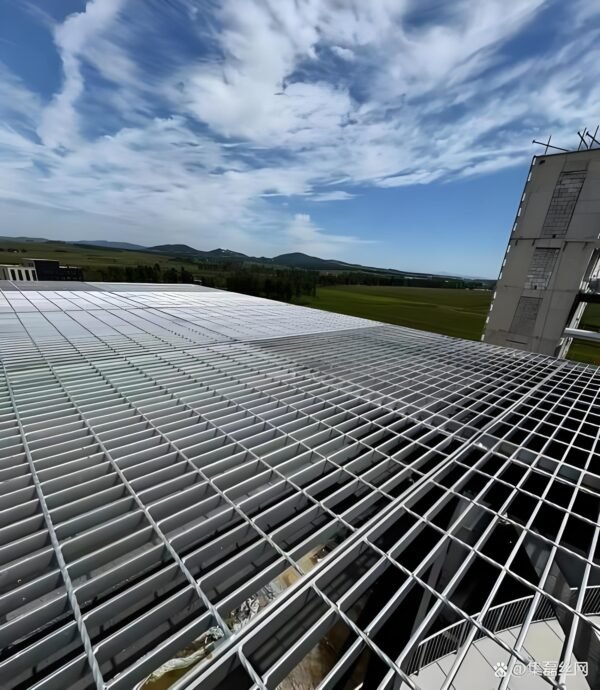
The grid structure of treads provides natural drainage advantages. With open area reaching ≥60%, rainwater, cleaning water, and oils drain quickly through the mesh, preventing surface water accumulation and icing—significantly improving winter slip safety. This characteristic makes treads the ideal choice for outdoor stairs, offshore platforms, and wet workshops.
✅ Modular Design – 30% Faster Installation
Treads feature standardized modular design—widths determined by bar spacing modules (30/40/60mm), lengths customizable in 100mm increments. On-site installation requires only simple welding or bolting, improving construction efficiency by over 30% compared to traditional cast-in-place treads, with dimensional errors controlled within ±2mm.
Four Model Series – Precisely Matching Installation Requirements
Based on installation method and structural characteristics, treads are classified into four standard types:
| Model | Fixing Method | Edge Banding | Front Nosing | Features | Application Scenarios |
| T1 | Welded | Same bar as bearing bars | No | Economical and durable, welded directly to stringers—lowest cost | Permanent industrial stairs, locations requiring no disassembly |
| T2 | Bolt | 65×5mm bar banding with holes | No | Detachable, reusable, flexible installation | Locations requiring regular maintenance, temporary facilities |
| T3 | Welded | Same bar as bearing bars | Yes | Enhanced edge slip resistance with front nosing | High-safety industrial stairs, humid environments |
| T4 | Bolt | 65×5mm bar banding with holes | Yes | Detachable + front nosing—combines safety and flexibility | Public facilities, high-safety locations requiring maintenance |
Note: Front nosing typically uses 65×5mm flat bar or patterned steel plate, height matched to tread dimensions, providing edge protection and slip warning.
Application Scenarios: Comprehensive Coverage from Industrial to Commercial
Leveraging its exceptional slip resistance, high load capacity, and aesthetic appearance, tread grating has been widely adopted across diverse scenarios:
| Industry | Application Scenarios | Recommended Models | Special Requirements |
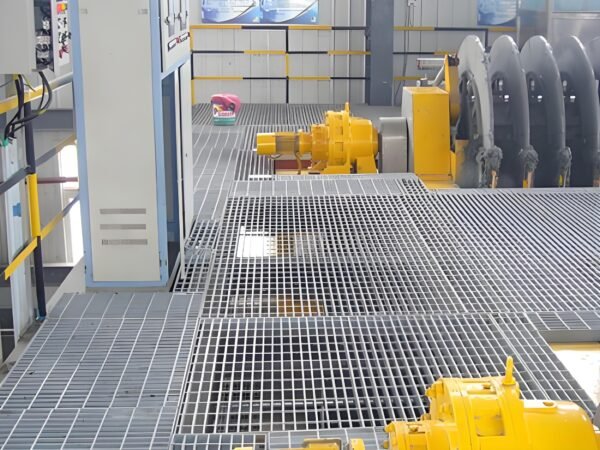
| Industrial Buildings | Power plant maintenance stairs, chemical plant operating platforms, machine shop walkways | T1/T3 welded + serrated bars | Heavy loads, oil resistance, corrosion resistance |
| Commercial Buildings | Shopping mall atrium stairs, hotel interior stairs, office building fire escapes | T4 bolted + stainless steel | Aesthetic appearance, transparency, coordination with decoration style |
| Public Facilities | Subway evacuation stairs, railway station walkways, school stairs, hospital corridors | T2/T4 bolted + anti-slip strips | High traffic, wear resistance, safety priority |
| Marine Engineering | Offshore platform gangways, ship stairs, dock maintenance ladders | T3/T4 + 316L stainless steel | Salt spray corrosion resistance, extreme slip requirements |
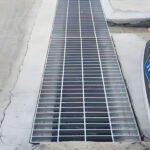
| Municipal Engineering | Pedestrian bridge ramps, park landscape stairs, riverbank inspection ladders | T2/T4 + hot-dip galvanized | Outdoor exposure, balancing aesthetics and durability |
Typical Application Cases:
Large shopping mall interior stairs utilize steel grating treads—transparent structure avoids heaviness; hot-dip galvanized surface complements modern decoration styles
Machine shop multi-story facility—treads withstand frequent worker traffic and small equipment handling loads
Subway station stairs under high traffic and rainy conditions—tread drainage and slip resistance effectively ensure passenger safety
Specifications & Selection Guide
Standard Width Recommendations (Based on 5mm Thick Bars)
| Bar Spacing | Applicable Models | Recommended Width Series (mm) |
| 30mm | T1-T4 | 125, 155, 185, 215, 245, 275, 305 |
| 40mm | T1-T2 | 125, 165, 205, 245, 285, 325 |
| 40mm | T3-T4 | 115, 155, 195, 235, 275, 315 |
| 60mm | T1-T2 | 185, 245, 305 |
| 60mm | T3-T4 | 155, 215, 275 |
Economy Suggestion: Use the above modular widths whenever possible to avoid non-standard dimensions that increase costs and extend delivery times.
Common Model Examples
| Model | Description | Application Scenarios |
| T1-G253/30/100 | Welded fixing, no front nosing, 25×3mm bars | Light walkways, pedestrian stairs |
| T3-G305/30/100 | Welded fixing, with front nosing, 30×5mm bars | Industrial platforms, heavy-load stairs |
| T4-G325/30/100S | Bolt fixing, with front nosing, 32×5mm serrated bars | Public facilities, high slip resistance |
| T2-304/40/100 | Bolt fixing, 304 stainless steel, no front nosing | Food processing plants, coastal buildings |
Material Selection
| Material | Surface Treatment | Application Environment | Service Life |
| Q235 Carbon Steel | Hot-dip galvanized (≥85μm) | Standard industrial, general indoor/outdoor | 15-25 years |
| Q355B High-Strength Steel | Hot-dip galvanized | Heavy industrial, impact loads | 20-30 years |
| 304 Stainless Steel | Pickling/passivation, brushed finish | Food/pharmaceutical, marine climate | 30-50 years |
| 316L Stainless Steel | Electro-polishing | High-corrosion environments, offshore platforms | 50+ years |
| 6061 Aluminum Alloy | Anodized | Lightweight requirements, ship gangways | 20-30 years |
Slip Resistance Options
| Anti-Slip Type | Characteristics | Application Scenarios |
| Serrated Bars | Serrated surface, friction coefficient ≥0.6 | Most industrial and commercial applications |
| Patterned Steel Nosing | Edge-mounted patterned plate, enhanced warning | High-safety requirements, public facilities |
| Polyester Anti-Slip Coating | Epoxy spray, anti-static | Oil depots, mines, explosion-proof areas |
| Anti-Slip Strips | Intermittently welded strips, lower cost | Standard industrial stairs |
Installation Guide
Fixing Method Options
| Method | Operation | Advantages | Disadvantages | Application Scenarios |
| Welded Fixing | Direct welding to stringers, weld length ≥40mm, leg height ≥4mm | Secure and reliable, low cost | Non-detachable, requires on-site welding | T1/T3 types, permanent installations |
| Bolt Fixing | Side plate holes, M12 stainless steel bolts, torque ≥50N·m | Detachable, reusable, quick installation | Slightly higher cost | T2/T4 types, locations requiring maintenance |
Pre-Installation Preparation
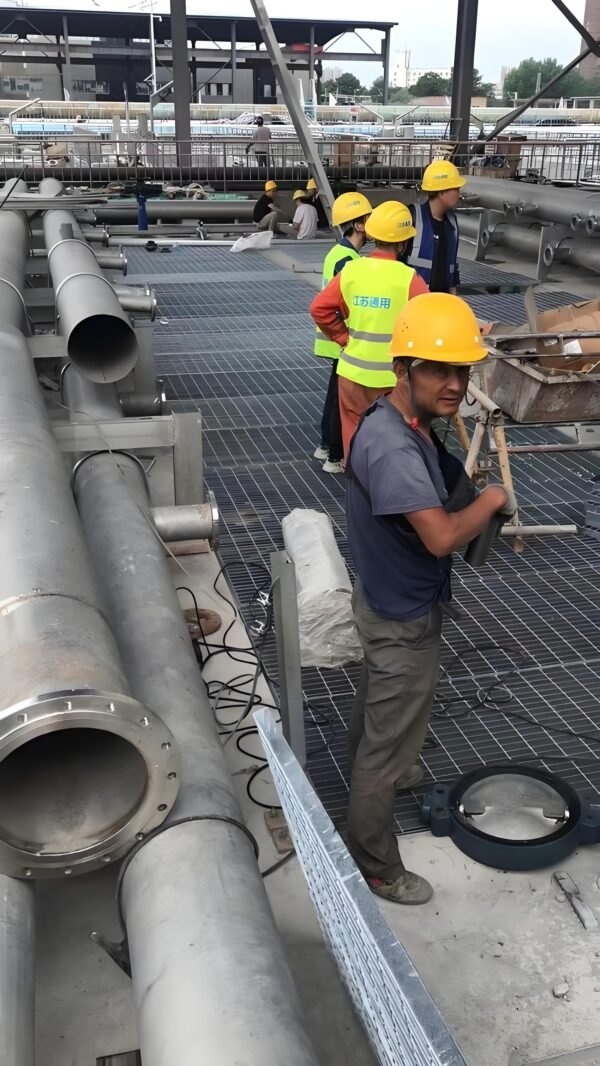
Base inspection: Stair foundation structure firm and level; tread dimensions meet design requirements, errors within allowable range
Surface cleaning: Remove debris and dust from stair surfaces, ensuring clean installation area
Material verification: Confirm tread models, dimensions, and quantities match order
Installation Points
Load direction: Bearing bars must be oriented perpendicular to stair stringers, ensuring force transmission along bars
Flatness control: Height difference between adjacent treads ≤5mm; total height cumulative error ≤10mm
Weld treatment: Clean slag after welding, touch up with zinc-rich paint for corrosion protection
Front nosing alignment: Front nosing aligned with tread edge, deviation ≤2mm
Anti-slip strip orientation: Correct strip orientation to effectively increase friction
Acceptance Criteria
Dimensional inspection: Tread height difference ≤5mm, width W ±3mm, length L -3mm
Load test: 1.5× design load applied for 24 hours, deflection ≤ L/200
Slip resistance verification: 35° incline with water spray test, friction coefficient ≥0.5
Visual inspection: Welds full, no porosity, no slag inclusion; galvanized coating uniform and complete
Why Do Global Buyers Choose Us as Their Long-Term Supplier?
✅ Full Industry Chain Deep Processing Capability
We operate a complete industry chain from bar rolling and automatic pressure welding to tread assembly. 5 fully automatic pressure welding lines + 3 tread-dedicated assembly lines with monthly capacity exceeding 5,000 tons ensure timely delivery of large orders. All deep-processing processes completed in-house, with quality control throughout.
✅ Full Series Models Available from Stock
T1, T2, T3, T4 full series treads regularly stocked, with complete standard width modules. Options including serrated bars, patterned steel nosing, stainless steel materials—all readily available. Standard specifications ship in 3-5 days; rush orders negotiable.
✅ Rigorous Quality Inspection System
Weld strength testing: Shear resistance 20-40kN/m², 100% weld penetration
Slip resistance testing: 35° incline water spray test, friction coefficient meets standards
Dimensional accuracy control: Width error ≤±3mm, length error ≤-3mm
Galvanized coating inspection: Zinc thickness ≥85μm, salt spray test exceeding 2,000 hours
✅ Participation in National Key Projects
Our tread products have been applied in:
Industrial projects: Thousands of maintenance stairs in large petrochemical enterprises
Commercial complexes: Interior landscape stairs in multiple city landmark shopping malls
Public transportation: Subway evacuation stairs, railway station walkways
Marine engineering: Offshore wind platform gangway systems
How to Select the Right Treads for Your Project
Step 1: Determine Fixing Method
Permanent installations, budget conscious → T1/T3 welded type
Regular maintenance required, detachable requirement → T2/T4 bolted type
Step 2: Determine Slip Resistance Level
General dry environments → Standard bars + T1/T2
Wet/oily environments, high safety requirements → Serrated bars + T3/T4
Anti-static requirement → Polyester anti-slip coating
Step 3: Determine Material
Standard industrial environments → Q235 + hot-dip galvanized (best cost-effectiveness)
Heavy loads, impact loads → Q355B high-strength steel
Marine/chemical environments → 304/316L stainless steel
Lightweight requirements → 6061 aluminum alloy
Step 4: Measure Dimensions
Stair width → Determine tread width (modular width recommended)
Stringer spacing → Determine tread length (load span)
Riser height → Determine front nosing size
Step 5: Contact Us with Drawings
Provide your stair parameters, load requirements, and application environment.
Our technical team will deliver professional solutions and quotations within 24 hours.
[Get Your Custom Stair Tread Solution Today]
Stop worrying about workers slipping. Stop worrying about stair water accumulation. Stop headaches over complex installation.
Choosing our stair tread & platform grating means choosing extreme safety with friction coefficient ≥0.6, 30 years maintenance-free performance, and quality assurance backed by participation in national key projects.
Click here to contact our engineers. Inquire today for free selection advice and case studies of similar projects!