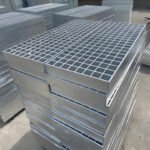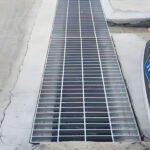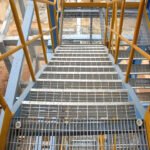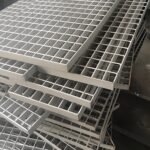


Stainless Steel Platform Grating – Material Grade Comparison (by Corrosion Resistance & Strength)
304, 304L, 316, 316L, Duplex – How to Choose the Right Material for Your Corrosive Environment?
In corrosive environments such as chemical plants, marine installations, food processing, and pharmaceutical facilities, the material selection for stainless steel platform grating directly determines service life, safety, and maintenance costs. Choosing the wrong grade can lead to pitting, crevice corrosion, or even stress corrosion cracking; over‑specifying adds unnecessary cost.
This article systematically compares the five most common stainless steel grades based on corrosion resistance and strength, helping you make a scientifically sound and economical selection.
1. Quick Overview of Five Common Stainless Steel Grades
| Grade | Cr% | Ni% | Mo% | Tensile (MPa) | Yield (MPa) | Corrosion Resistance Rating | Relative Cost |
|---|---|---|---|---|---|---|---|
| 304 | 18-20 | 8-10.5 | – | ≥515 | ≥205 | ★★★ | Baseline |
| 304L | 18-20 | 8-12 | – | ≥485 | ≥170 | ★★★ | Slightly above 304 |
| 316 | 16-18 | 10-14 | 2-3 | ≥515 | ≥205 | ★★★★ | ~1.3x |
| 316L | 16-18 | 10-14 | 2-3 | ≥485 | ≥170 | ★★★★ | ~1.35x |
| 2205 Duplex | 22-23 | 4.5-6.5 | 3-3.5 | ≥620 | ≥450 | ★★★★★ | ~2-2.5x |
Note: The “L” in 304L and 316L stands for Low Carbon (≤0.03%). These grades offer better resistance to intergranular corrosion after welding.
2. Detailed Comparison of Each Grade
2.1 304 Stainless Steel – General Purpose, Best Value
Corrosion Resistance:
304 is the most commonly used austenitic stainless steel. It has good resistance to most organic acids, alkalis, and atmospheric environments. However, in environments containing chloride ions (Cl⁻) such as seawater, salt spray, or bleach, pitting can occur.
Strength:
Tensile ≥515MPa, Yield ≥205MPa – sufficient for most industrial platform loads.
Typical Applications:
- Indoor platforms in food processing plants (dry or mild detergent environments)
- General industrial plant walkways (no salt spray, no strong acids)
- Freshwater treatment facilities
- Architectural/decorative platforms
Not Recommended for:
- Coastal outdoor environments (salt spray)
- Chemical plants with strong acids or chlorides
- Seawater immersion or frequent saltwater washing
2.2 304L Stainless Steel – Preferred for Welded Structures
Difference from 304:
304L has lower carbon content (≤0.03% vs. ≤0.08% for 304). During welding, it is less prone to chromium carbide precipitation in the heat‑affected zone, thus avoiding intergranular corrosion. For platform structures requiring extensive welding, 304L is a safer choice.
Typical Applications:
- Platforms requiring field welding or numerous welds
- Situations where post‑weld solution treatment is not possible
- Same general corrosive environments as 304, but with denser welds
2.3 316 Stainless Steel – Chloride Resistant, Entry Level for Marine
Corrosion Resistance:
316 contains 2-3% molybdenum (Mo), significantly improving resistance to chloride pitting and crevice corrosion. It performs far better than 304 in marine atmospheres, brine, bleach, etc.
Strength:
Similar to 304 – Tensile ≥515MPa, Yield ≥205MPa.
Typical Applications:
- Coastal outdoor platforms (not directly immersed)
- Chemical plants with chlorides or acidic media
- Pharmaceutical equipment platforms (general clean areas)
- Wet areas in food processing plants (frequent washing)
Limitations:
In high‑temperature chloride environments (e.g., >50°C seawater) or long‑term immersion in high‑concentration chlorides, 316 can still suffer pitting or stress corrosion cracking.
2.4 316L Stainless Steel – Best Performance After Welding, Top Choice for Aggressive Environments
Difference from 316:
316L has lower carbon content (≤0.03%) than 316. It does not sensitize after welding and offers superior resistance to intergranular corrosion. For welded platform structures, 316L is a more reliable choice than 316.
Typical Applications:
- Offshore platforms (including splash zones)
- Seawater desalination plant platforms
- Chemical plants with strong acids, alkalis, chlorides
- Pharmaceutical cleanrooms (frequent sterilization)
- Food plant high‑temperature, high‑humidity wash zones
Expected Service Life:
In typical marine atmospheric environments, 316L platform grating can last over 50 years.
2.5 2205 Duplex Stainless Steel – High Strength, Superior Corrosion Resistance
Microstructure:
Duplex stainless steel consists of approximately 50% ferrite and 50% austenite, combining the advantages of both.
Corrosion Resistance:
- Pitting Resistance Equivalent (PREN) >35, much higher than 316L (approx. 25-30)
- Excellent resistance to chloride‑induced stress corrosion cracking
- Resists many strong and organic acids
Strength:
Yield strength ≥450MPa – about twice that of 304/316. Under the same load, thinner bars can be used, reducing platform weight.
Typical Applications:
- Heavy‑load areas on offshore drilling platforms
- Seawater heat exchanger platforms
- Chemical plants with high‑concentration chlorides or acidic media
- Paper mill bleach plants
- High‑strength platforms where weight reduction is needed
Cost Consideration:
2205 material cost is approximately 2-2.5 times that of 304. However, in extremely corrosive environments, its long service life and low maintenance can justify the initial investment.
3. Material Selection Decision Tree
Use the logic below to select the appropriate grade:
text
Does the environment contain chlorides (Cl⁻)?
├─ No → 304 or 304L (choose 304L if many welds)
└─ Yes →
    ├─ Is it coastal outdoor with occasional salt spray?
    │   └─ Yes → 316 or 316L (316L if many welds)
    └─ Is it seawater immersion, high‑concentration chlorides, or high temperature?
        └─ Yes → 2205 Duplex
4. Welding Considerations
| Base Material | Recommended Filler Wire | Post‑Weld Treatment |
|---|---|---|
| 304 | ER308 | Pickling & passivation |
| 304L | ER308L | Pickling & passivation |
| 316 | ER316 | Pickling & passivation |
| 316L | ER316L | Pickling & passivation |
| 2205 | ER2209 | Pickling & passivation |
Important: After welding, all stainless steel platform grating must undergo pickling and passivation to remove heat tint and the chromium‑depleted layer in the heat‑affected zone, restoring corrosion resistance. Our plant provides a blue dot test report with every batch.
5. Quick Selection Table (by Environment)
| Environment | Recommended Grade | Example Model | Key Requirements |
|---|---|---|---|
| Indoor dry, general industry | 304 | G325/30/100 SS304 | Economical, practical |
| Food plant wet areas, frequent washing | 304 or 316 | G255/30/100F SS304 | Serrated anti‑slip, easy clean |
| Coastal outdoor, salt spray | 316L | G325/30/100F SS316L | Pickled & passivated |
| Chemical plant, strong acids/chlorides | 316L or 2205 | G405/30/100 SS316L | Heavy duty, corrosion resistant |
| Seawater immersion, offshore platforms | 2205 | G505/30/100 2205 | High strength, superior corrosion resistance |
| Pharmaceutical cleanroom, sterilization | 316L | HF-G325/30/100 SS316L composite | No dead corners, mirror polish |
6. Summary
- 304: General purpose, best value – for indoor or dry environments without chlorides.
- 304L: Preferred for weld‑intensive platforms – avoids intergranular corrosion.
- 316: Chloride resistant – suitable for coastal outdoor and general chemical plants.
- 316L: Best choice for welded platforms in corrosive environments – widely used in marine, chemical, and pharmaceutical industries.
- 2205: High‑performance choice for extreme corrosion – high strength, long service life.
If you are unsure which grade matches your environment, please contact us. We can provide a free material recommendation report based on your media composition, temperature, humidity, and other parameters.